

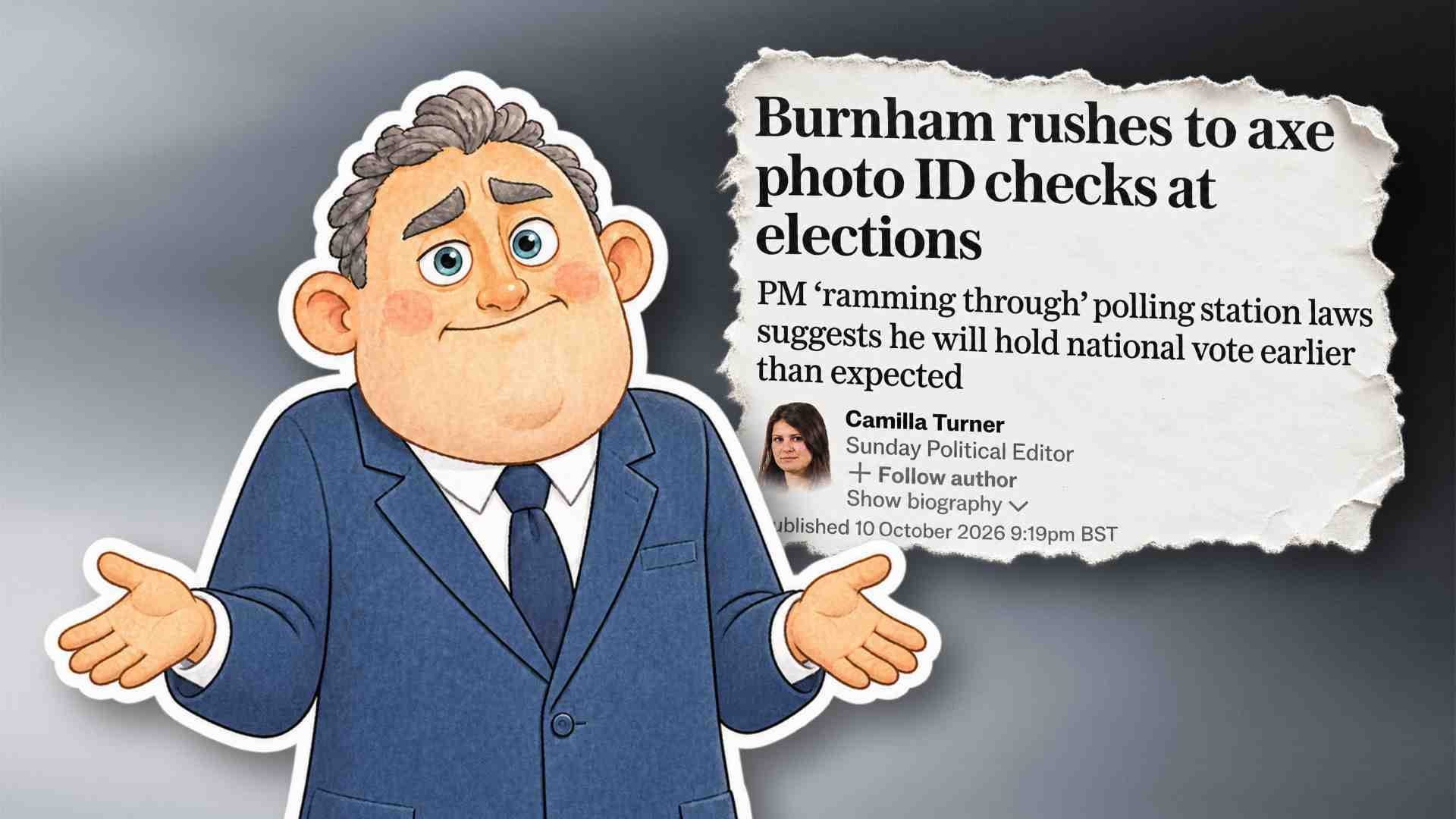
Since last night, the right wing on X/Twitter has concluded that Andy Burnham wants to rig the next election. The spark that triggered the hullabaloo was a Telegraph headline: “Burnham rushes to axe photo ID checks at elections”. A Telegraph opinion piece went further with the serpentine line: “Quite why Labour wants to make electoral fraud easier to commit is unclear.” Burnham is neither axing photo ID nor unleashing a torrent of electoral fraud.
So if someone raises this with you over Sunday lunch, or in the pub tonight, you know where they got it from - and you can use this article to put them straight.
A fix for a problem that barely exists
The Elections Act 2022 introduced a requirement to show photo ID before voting. At the time, the justification for the change put forward by the then Conservative government was something called personation: someone turning up and voting as somebody else. Police figures show how vanishingly small a problem that is. In 2022, before anyone needed photo ID, police recorded seven – not seven-thousand, or seven-hundred, just seven - allegations of personation at polling stations. And none of those allegations were so serious that they resulted in a conviction in a court of law. In 2023 there were two, and in 2024 seven. None of those led to a conviction either. It’s a mystery why this requirement was introduced at all when a bigger percentage of the population believes Elvis is still alive than commits personation. (Note: The Ugly Politix stats checkers are off today - the Elvis thing might not be 100% correct. Don’t sue me.)
So, a huge imposition of red tape to address the actions of sixteen wrong-uns in three years. And the impact on honest voters? At the July 2024 general election, the Electoral Commission says about 50,000 people were turned away for lacking the right ID. Around two-thirds of them came back later with the right paperwork, but by close of poll about 16,000 had not.
A list that made little sense
Part of the problem is the list itself. In England, an older person’s bus pass counts, and in London so does an Oyster 60+ card. But a student’s 18+ Oyster photo-card doesn’t, and nor does a 16–25 Railcard. Older people’s travel passes are in. Young people’s aren’t.
Those without valid ID can obtain a free Voter Authority Certificate - a paper photo ID just for voting - but they have to know about it (many don’t) and apply well in advance of election day to get one. And who among us, busy earning a living and/or raising a family thinks about elections that much ahead of time?
Ever since the Act brought voter ID in, Open Britain has said the list was unhelpfully narrow and should be widened so it doesn’t stop people voting, especially the groups least likely to hold a passport or driving licence. The current government’s explanatory notes for this bill say the change helps voters “less likely to hold currently accepted ID, such as younger electors or those with disabilities”. That gets a big tick from me.
So, what does the bill actually do?
The Representation of the People Bill keeps the rule that you must show ID, and every photo ID that counts now still will in future. It just adds one thing: a valid UK bank card showing your name as it appears on the electoral register. It also sets checks for digital versions of accepted ID, like the coming digital driving licence. The government’s research says the share of people with no accepted ID would fall from 2–4% to under 1%. Again, that seems right to me.
The honest, real-world maths
The molehill that the Telegraph’s is trying to convert into a mountain is this: A bank card has no photo. The Electoral Commission accepts that the lack of a photo makes it “less secure” and harder for staff to check you are who you say you are. In theory, someone could turn up with a relative’s card. Note, in theory.
But picture the scenario in the real world, not the theoretical one that policy wonks live in. A polling clerk, sitting in one of the many polling stations where people are casting their votes at the next election. Someone rocks up and gives a name and address that match the register and hands over a valid bank card with that name on it. Which is more likely? That this is one of the roughly 20 million people who vote honestly? Or one of those behind the seven polling-station allegations police received in the whole of 2024?
Asking that real-world question is what an evidence-based, risk-proportionate rule looks like. You don’t let a narrow list turn away thousands of registered voters to stop a vanishingly small number of cases, so minor that none led to a conviction.
Consider where this narrative could take us
I know Britain isn’t America, and our ID rule was never as extreme as the ones Trump tried to put in place over there. But America shows us where fraud talk without fraud evidence can lead. The idea of stolen elections still reverberates across the US, and still drives social division among the people.
In March 2025 Donald Trump signed an order, billed as protecting election integrity, requiring proof of citizenship, such as a passport or birth certificate, to register for federal elections. The Brennan Center, a US research group, estimates 21.3 million voting-age citizens don’t have those papers readily to hand. Now, happily, Federal courts blocked it, ruling he had no power to set those rules and the main parts of a second order this year, which names reducing voter fraud as its aim, were declared void by a judge in June. But he tried. He tried to prevent millions of people from expressing their democratic will. And there is a well-funded and highly organised network within the media and political system here who would be happy to do the same. We can’t allow that. Not if we want our country to be more than a democracy in name only.
Your job today
If someone brings this story up over Sunday lunch, tell them straight that it’s nonsense. Direct them to this piece, if you wish. “Photo ID stays. Bank cards are added. And the fraud these people claim they want to stop barely exists. Now, please pass the carrots.”
Enjoy your Sunday.

I am one of those people who doesn’t have photo identification. I am severely sight impaired and I really don’t want to leave the country so I won’t pay for a passport and despite advice given to me by a job centre employee that I get a provisional driving licence I can’t get one! All photo identification has to be paid for which I understand, but there are so many different types available I honestly don’t know which one would be accepted.
I welcome the new rule of bank cards being accepted as valid forms of identification. I hope they will be accepted by the government when I’m trying to sort out my benefits!
Monkeys know their own tricks best.