

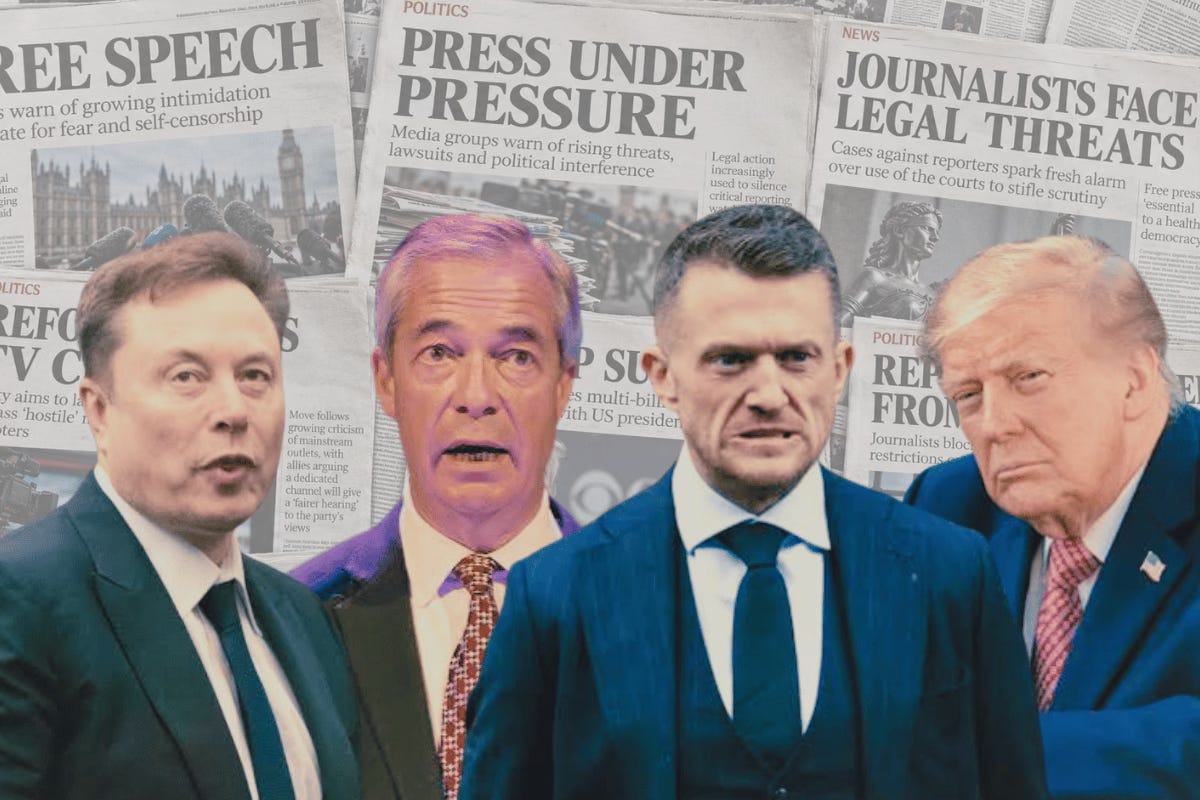
Tommy Robinson faces up to ten years in prison after being convicted of harassing two journalists and causing them to fear violence.
The Mail had reported that he was “stoking riots from his sunbed” during the 2024 unrest. Robinson responded by hiring private investigators to find journalists’ home addresses and publishing photographs of their homes and one reporter’s family online.
Police said his threatening posts encouraged his followers to target and intimidate them.
There is a history here, stretching back to his UKIP days.
In 2019, while working as a UKIP consultant, Robinson targeted journalist Mike Stuchbery’s turning up at his home late at night.
In 2021, he received a five-year stalking protection order after turning up at Independent journalist Lizzie Dearden’s home. The magistrate found that he had gone there to intimidate her and stop her carrying out legitimate investigations.
Robinson has repeatedly tried to make scrutiny personally dangerous.
What worries me is how easily the bigger story is getting lost. Reporting on the far right is becoming more frightening, more expensive and simply difficult to do. At the same time, the right and its wealthy backers are pouring money into media they control. Their publicity gets a bigger audience, while the journalism that might challenge it becomes harder to produce.
The price of asking questions
We’ve recently covered Reform’s problem with journalists.
Now there’s ITV. Its undercover investigation exposed racism by Reform councillors and candidates. Reform announced police complaints and legal action against journalists and the broadcaster’s board. Zia Yusuf promised: “We will pursue this through the courts relentlessly.”
“Relentlessly” is an expensive word when you’re the one who might have to pay to defend your work.
The National Union of Journalists condemned what it described as “SLAPP-style” intimidation - legal pressure used to deter reporting in the public interest.
Independent journalism can be a real problem for people who want to control the story. A reporter with documents, sources and footage can reach people beyond a party’s own supporters and give them a reason to question what they’ve been told.
A party can put out as many reassuring videos as it likes. The evidence is still there.
That’s what gives journalism its power.
The trouble is, being right can still cost a fortune. An editor can stand by every word of an investigation and still worry about whether the publication can afford to defend it.
This is already affecting the stories we get to read. Research for the government found that worries about safety were leading some journalists to hold back or change how they reported. Freelancers and smaller newsrooms often have less support to fall back on when trouble came.
Then there are the stories we never get to read. An editor decides they can’t risk another legal bill. A source decides speaking out is too dangerous. A reporter can’t face putting their family through it again.
Our democracy is weaker for the stories we never get to read—and we may never know what we’ve missed.
Reform’s expanding media operation
While independent newsrooms worry about whether they can afford the next investigation, Reform’s new newspaper has started dropping through letterboxes this week.
In The Reformer, Farage explains: “We have had enough of what we say and do being distorted by the media.” His solution is a publication where his party controls the coverage.
The newspaper is part of a much bigger operation. Their £72 million from Christopher Harborne and Ben Delo is helping finance Reform’s media expansion, including a daily YouTube channel with an estimated initial budget exceeding £10 million.
They are creating a political system drowning in content and starving of accountability.
Trump’s America is already showing us where this can lead.
In July, New York Times journalists faced subpoenas over reporting on security concerns surrounding Trump’s new Air Force One. Prosecutors sought testimony and phone records, then withdrew the demands after a judge challenged their handling of the case.
CNN, Politico and MS NOW were banned from the White House. A judge intervened, but the battles over access to presidential events and Air Force One continued. News organisations have had to keep going back to court to defend their ability to cover an elected president.
Then there’s Paramount. Last year, CBS’s parent company agreed to a $16 million settlement over Trump’s lawsuit about the editing of a Kamala Harris interview. Paramount had maintained that the case was without merit. It was also waiting for regulatory approval for its merger with Skydance.
The journalists were reporting on a president whose administration had power over their commercial future. That’s a formidable source of pressure before anyone in the newsroom has picked up a phone.
The pressure can reach the editor through the boardroom.
Meanwhile, Trump TV offers round-the-clock White House-sanctioned content. Sound like a familiar model?
It would be comforting to think this was all happening safely on the other side of the Atlantic.
Robinson says Elon Musk is paying his legal costs. The man who owns X, the platform Robinson used to target the journalists, is also the man he credits with funding his defence. Musk has appeared by video at a Robinson rally, calling for a change of government in Britain. This is also a man who has described himself as a “free speech absolutist”.
Investigating a political party and those shaping our politics is an exercise in freedom of expression. So is publishing evidence they would rather nobody saw. Any commitment to free speech worth taking seriously has to protect that too.
The Trump administration has publicly promised to fund “free speech” initiatives in allied Western countries. Reuters reported on discussions with Reform about plans to fund ideologically aligned organisations and a proposed $4 million for right-wing media in Europe.
Washington’s enthusiasm for our freedom of expression comes with some extremely specific political preferences.
An administration putting pressure on critical journalism at home is offering support for its preferred version of free speech abroad. British politicians and organisations are already in those conversations.
These are relationships being built between people with money, platforms and an interest in changing British politics.
Their methods vary. The pressures on journalists add up all the same. Threats make reporting frightening. Legal action can make it expensive. Refusing to answer journalists makes it harder. Huge donations help a party fill the space with material it controls.
The public end up hearing more from powerful people while finding out less about them.
That’s a very comfortable position for a politician who would rather avoid scrutiny. It’s also how authoritarian politics gets room to grow: fewer effective checks, fewer uncomfortable revelations, and more opportunities to tell supporters that the people asking questions are the enemy.
Our democracy is being eroded right in front of us.
The warning signs rarely arrive neatly labelled. They turn up as another row with a reporter, another legal threat or another billionaire’s cheque. It’s easy for each one to become yesterday’s news while the people involved carry on building their power.
People asking to govern us should have to survive difficult questions. People bankrolling them should have to survive investigation.
Their money should never buy them the power to make either disappear.
The law needs to be changed to put a stop to this. Do away with Slapp so public figures no longer have protection that they don't deserve. Make harassing journos easier to prosecute and convict.
It may be that Reform an anti British pro Russian company are breaking commercial law. Prosecute and jail their leaders if they do.