

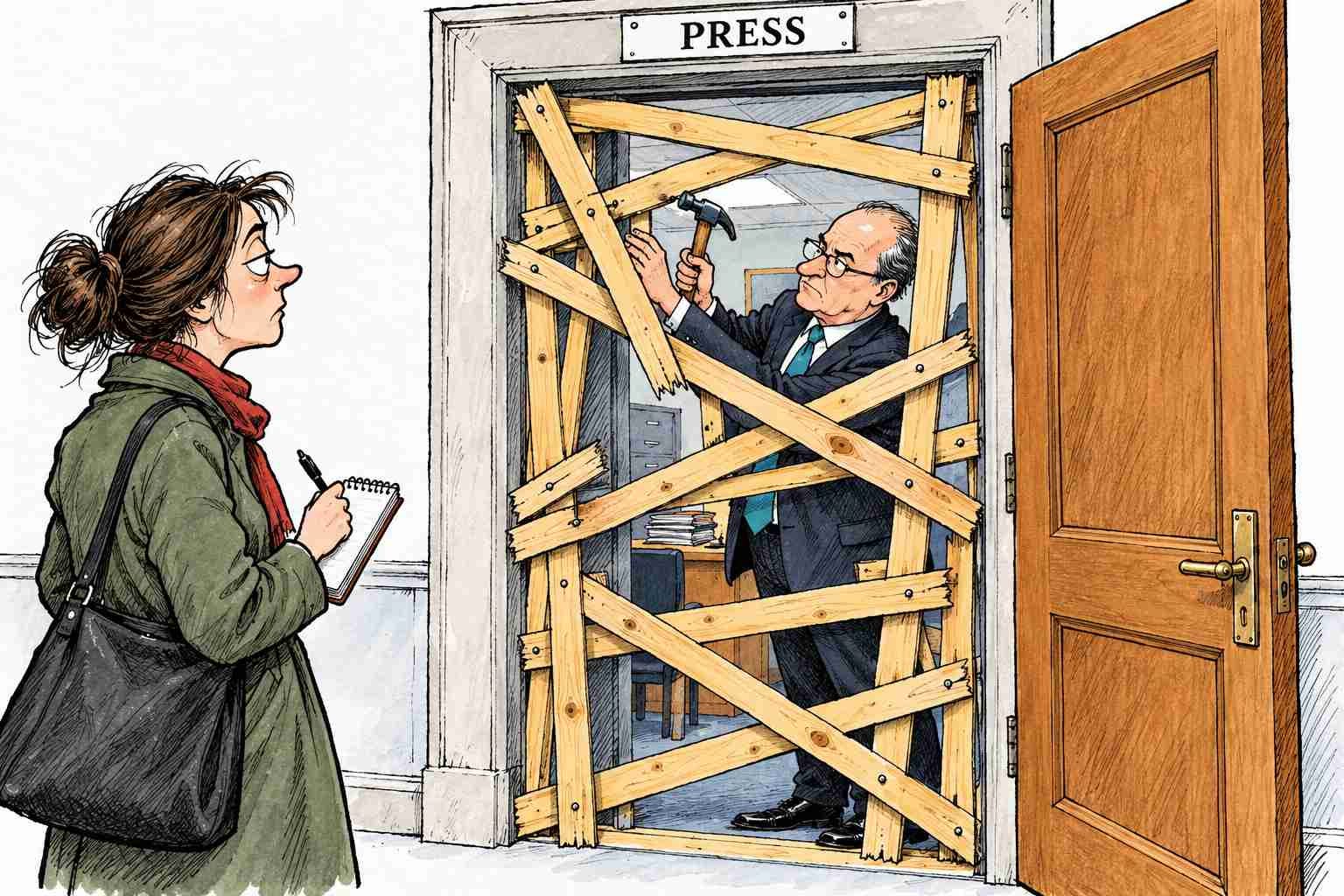
Reform UK has found a simple way to deal with a journalist whose reporting it dislikes.
Stop answering him.
That is what Reform-run Derbyshire County Council has decided to do with Local Democracy Reporter Eddie Bisknell after taking exception to his coverage.
The council says this does not amount to banning him. Bisknell can still attend meetings he has a legal right to attend. He can still write about the council. He can still send questions.
They just won’t answer them.
That is a remarkably narrow definition of press freedom.
Bisknell had questioned council claims about a dramatic fall in the number of potholes in Derbyshire. He had also reported on an 81-year-old woman’s dispute with the authority over a fence blocking access between her garden and a council car park.
If the council thought his reporting was wrong, it had plenty of options. Publish the evidence. Challenge the figures. Make a complaint.
Instead, its deputy leader says Bisknell will now have to work “twice as hard”.
That sounds an awful lot like a warning to journalists about what happens when their reporting annoys the people in charge.
Reform keeps doing this.
A Reform administration in Nottinghamshire previously restricted journalists’ access after objecting to coverage and backed down after the threat of legal action. Reform politicians in Suffolk have discouraged engagement with local media. Last month, the national party refused conference accreditation to three journalists who had produced critical reporting about Reform and people funding it.
Natalie Fahy, editor-in-chief at Reach, has documented the problem across Reform-run councils. One response from Ipswich Reform chairman Shayne Pooley is particularly revealing: “Neither we or the voters need you.”
That deserves more attention than it got.
Reform might genuinely believe it no longer needs journalists.
Nigel Farage has a huge audience online and a prominent platform on GB News. Reform can reach millions of people directly through social media. Following the extraordinary £72 million it received from two donors last month, the party is reportedly considering spending some of that money on an even bigger media operation of its own, including Reform TV.
You can see the attraction.
Journalists are annoying.
They check things.
They ask about the figure that does not add up.
They notice when today’s explanation does not match yesterday’s.
They sometimes ask another question after the politician has already given the answer they wanted to give.
A political party with its own enormous communications machine can increasingly avoid all of that.
Pooley’s second claim is where the problem lies.
Voters absolutely do need journalists.
Someone has to keep watch
Local journalism has already been stripped back across Britain.
Media Storm recently devoted an episode of their podcast to what that means for democracy, highlighting the closure of more than 320 local titles between 2009 and 2019 and some pretty worrying research showing that people are less likely to vote where local news is weaker.
Media Storm summed up the problem “bad journalism is bad for democracy, bad for community - and good for disinformation.”
That is why this should not be dismissed as a petty local spat.
Most people are not going to spend their evenings reading council committee papers. They will not compare claims made in a press release with the underlying numbers. They will not know that a planning decision buried on page 176 deserves attention.
Local reporters do that work.
They ask where the money went.
They talk to the resident whose experience does not match the official line.
They sit through the meetings everyone else would rather avoid.
Sometimes they ask the question the people running the council would rather nobody asked.
That is democracy doing its job.
The idea that politicians can simply stop engaging with journalists they dislike is dangerous for a very obvious reason.
A council should not get to choose which reporters are sufficiently agreeable to receive answers.
A government certainly should not.
We have seen this playbook before
Reform has never been shy about borrowing from Donald Trump and MAGA.
This looks familiar too.
Trump has spent years attacking journalists, rewarding friendly media and trying to control who gets access to him and his administration.
Since returning to the White House, that has gone beyond insults.
The Associated Press was excluded from presidential events after refusing to adopt the administration’s preferred name for the Gulf of Mexico. The White House has asserted greater control over which organisations get access to presidential events. Other major news organisations have since ended up in court fighting restrictions.
America shows where this instinct can lead.
Once politicians believe access belongs to them to give and take away, critical journalism becomes much easier to punish.
Once politicians have huge friendly media ecosystems and direct channels to millions of supporters, they have less incentive to tolerate journalists who make their lives difficult.
Reform already has both parts of that equation.
It has the alternative media ecosystem.
Now, wherever it gets power, we keep seeing signs of the other part.
Journalists who upset Reform find doors closing.
Today it is potholes
Today, the row is about potholes - but Reform wants to govern Britain.
That should change how seriously we take what is happening in Derbyshire.
What happens when the journalist is asking about a multimillion-pound government contract? Or a minister’s financial interests? Or foreign interference?
We should judge what Reform might do with national power partly by looking at what it does with the power it already has.
Why should anyone assume greater power would make it more tolerant of scrutiny?
America is showing, in real time, what can happen when a political movement that already distrusts independent media gains enough power to start deciding who gets access.
Press freedom does not have to vanish overnight to be damaged.
It can be chipped away one journalist at a time.
One unanswered question. One revoked pass. One newsroom frozen out.
Each incident can be dismissed as petty, personal or insignificant. That is exactly how the line moves.
Journalists, civil society and anyone who cares about transparency and fair information should be making a lot more noise about what is happening in Derbyshire, even if the latest story was about potholes.

I too could also see the parallels between Reform and the Trump junta so thank you for your piece.
As you say it's a warning to all of us who care about democracy on what life would be like under the obnoxious Farage and his fellow oiks.
WELL
The press are not on their own
I was bard from my Pendle-Colne in Lancashire Cllr meeting year age
They also refused me face to face meeting with all party Cllr
They then stopped reply to my emails covering up their personal Cllr mess
before we started to investigation them all for miss uses of our public funds
the investigation are still going on today in Pendle-Colne areas by us residents.