

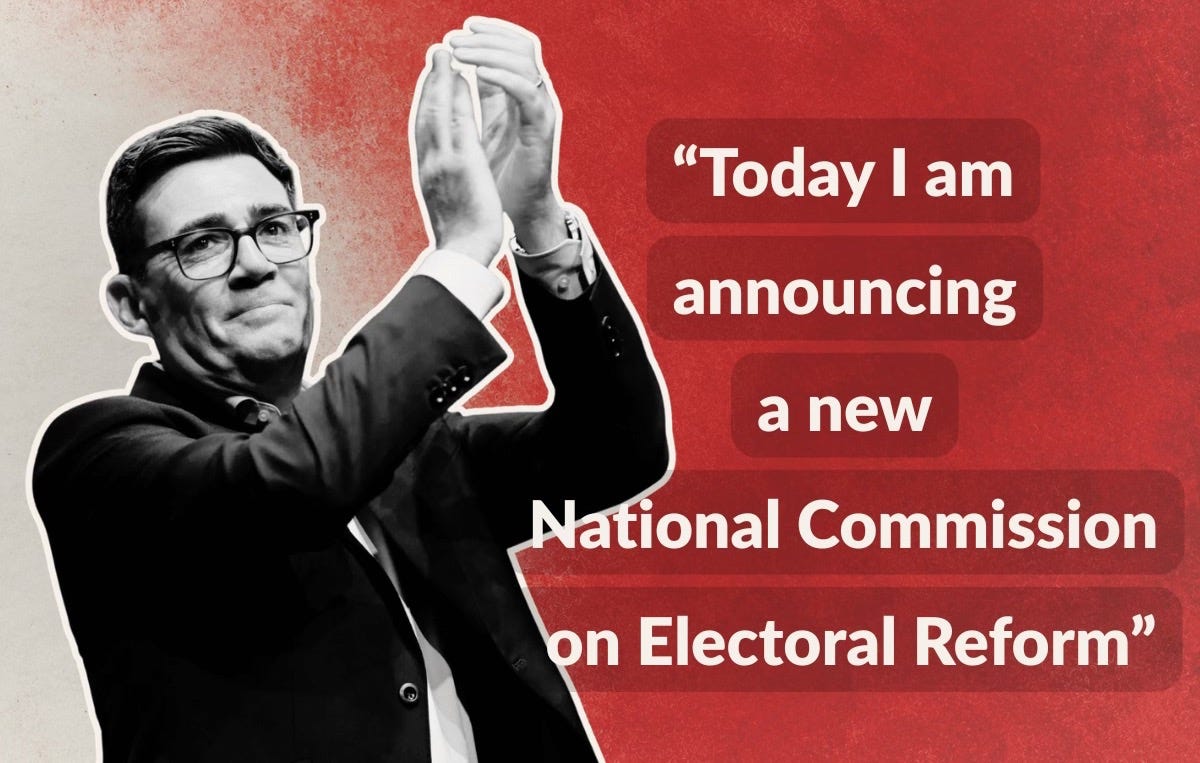
We went to Labour conference this week to make the case for fairer votes. From the main stage, Andy Burnham answered that call with a National Commission on Electoral Reform.
At last, we had a Prime Minister taking people’s call for fairer votes seriously and making it part of his plan for Britain.
Running through his speech was the idea that people should have more power over the decisions that shape their lives.
Burnham talked about who controls the things people rely on every day, from housing to water and energy. “We rely on them, we pay for them,” he said, making the case for stronger public control. He spoke, too, about Westminster’s failure to treat different parts of the country “equally and fairly”.
That principle reaches Parliament as well. The people who rely on those services elect the government responsible for them. Giving people more power over their lives includes giving them a fair say in who governs. Near the end of his speech, Burnham brought fair votes into that vision. He said his plan for Britain needed a change to our politics and that Labour would go into the next election committed to changing the voting system so that every vote counts.
We had called on him to kick off a commission in his first 100 days as Prime Minister. This was day 72. I think we’re allowed to enjoy that for a moment.
This summer, thousands of people signed our petition backing that call, and we took their names and comments to Downing Street. Asking people to sign a petition is one thing. Thousands of people also took the time to explain what was wrong and what they hoped could change. I spent time reading what they wrote. They described the frustration of voting in a place where the result feels decided before they turn up, or watching Parliament take shape in a way that bears little resemblance to how people voted across the country.
What stayed with me was their willingness to try to change it. People who had plenty of reasons to be fed up with politics still put their names to a proposal for a serious public conversation about how we elect MPs. They believed Britain could do better, and they wanted to be part of working out how.
Their comments make Burnham’s broader principle of ownership feel very real. Burnham recognised the gap between winning power and earning broad support. He warned that the current rules could put a government in Number 10 on less than 30% of the vote. Parliament makes decisions for the whole country. Its makeup should reflect how the whole country voted.
The voting system belongs to voters. Their experiences can help the commission understand what people expect from an election, where the current system falls short and what a fairer one should achieve. They will be asked to live with whatever rules come out of this process, so they deserve a meaningful role in reaching an answer.
Burnham also recognised how little trust many people have in politics. The comments we took to Downing Street showed some of the reasons why. If the commission brings voters into its work, takes their experiences seriously and shows how their contributions shaped its conclusions, people will be able to see that their views counted. That is how we make a decision about our voting system that people can trust.
A few months ago, I asked what political capital was for. Burnham has given us part of his answer. He used his first conference speech as Prime Minister to put the rules of politics among the things he is willing to examine. Prime Ministers do not often volunteer to look closely at the system that gave them the job.
The early signals are encouraging. This was a main-stage announcement, tied directly to his vision for change. He invited every party into the commission’s work, and Labour says voters of all parties and none will have the chance to participate. That is the right spirit for a question that belongs to the whole country. For those of us who have spent years making the case, hearing that from the stage was a moment to celebrate.
A commission is still the beginning of the job. Its independence needs to be beyond doubt. Voters need to shape its work in a way that can influence its conclusions, and people need to know what will happen when it reports. Those details will determine whether the process earns the confidence this moment deserves.
Burnham has put fair votes into his plan for giving people more power over Britain’s future. Now the process for deciding our voting system needs to live up to that promise. The people who helped bring this question to Downing Street should be able to help answer it.

A previous Labour PM, Tony Blair, promised a referendum on PR, and reneged.
I'll believe Burnham is serious when PR is actually implemented and not before.