

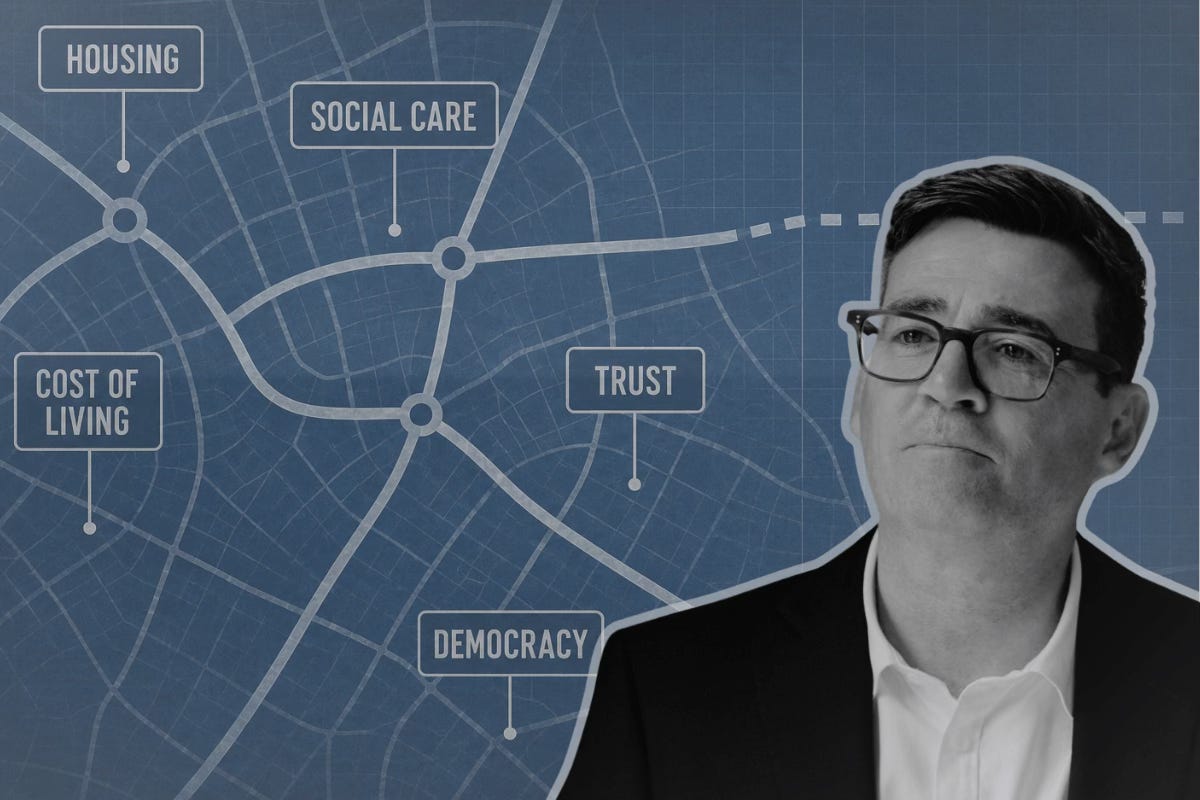
When Andy Burnham said he was prepared to spend political capital on fixing social care, it caught my attention.
Now, political capital isn’t exactly an unusual concept. Westminster runs on it. Advisers talk about it endlessly. Journalists are forever declaring that Prime Ministers have either accumulated it, squandered it or run out of it altogether.
What’s unusual is hearing a Prime Minister say it out loud.
Normally, politicians reach for softer language. They talk about mandates, difficult decisions, doing the right thing or making the tough choices. We all know what they mean. They’re talking about political capital without ever quite admitting it exists.
Burnham didn’t bother with the euphemisms. He acknowledged something every government knows but rarely says publicly: political capital is finite. You only get so much of it, and every big decision spends some.
There’s something refreshingly honest about that.
It also raises a much bigger question than social care.
What is political capital actually for?
Because if it’s a finite resource, surely the point isn’t simply to preserve it. It’s to spend it on the things that matter most.
Every Prime Minister has two things when they walk through the door of Number 10.
The first is political capital. Burnham certainly has some. More than 349 Labour MPs backed his leadership, and the polls suggest the public are still willing to give his government the benefit of the doubt. Like every new Prime Minister, he’s enjoying that brief period where goodwill is plentiful, authority is strong and people are prepared to believe change might actually be possible.
The second is inherited unfinished business.
Some of it is obvious. Social care. Housing. Living standards. The kind of stubborn problems that have outlived governments of every colour because they’re politically difficult as much as they are technically complicated.
Those are exactly the kinds of problems political capital should be spent on. Burnham is right about that.
But it also made me wonder whether we’ve been thinking about political capital too narrowly.
Those policy challenges don’t exist in a vacuum. Every government inherits them within a political system that has repeatedly made those problems harder to solve.
One of the things we talk about is how our voting system shapes almost everything else. Not because changing the voting system magically fixes social care or builds more homes, but because it changes the conditions in which governments govern.
When people believe their vote counts, they’re more likely to participate. When participation is stronger, governments enjoy greater legitimacy. When governments have greater legitimacy, they’re in a better position to take difficult decisions that last beyond a single Parliament instead of being endlessly revisited or quietly abandoned.
Politics becomes better at dealing with long-term problems when the institutions themselves better reflect what people actually want.
That’s why electoral reform has always struck me as slightly different from most constitutional debates. It isn’t simply another item on a government’s to-do list. It’s one of the few reforms that has the potential to make everything that comes afterwards work better.
Which brings me back to Burnham - and what else he could choose to invest his political capital in.
Governments usually spend their opening months deciding what they want to do. Burnham doesn’t have to start from a blank page. His government has something that’s rather unusual - a roadmap already sitting on his desk.
Last year’s elections strategy set out an ambitious programme to rebuild trust in politics. The Representation of the People Bill is already before Parliament, bringing forward important reforms to strengthen the way our elections are run, improve integrity and modernise participation.
But for all its ambition, it still leaves the biggest democratic question unanswered.
It looks at how we run elections. It doesn’t ask whether the voting system itself still does the job it was designed to do.
That’s the missing piece.
If rebuilding trust, ensuring voices are heard and views fairly represented are really the goals, then it’s hard to avoid asking whether the voting system itself is helping or holding us back.
Governments rarely begin with this much momentum. Even fewer have a piece of unfinished work that already has broad political support, a legislative route through Parliament and the potential to make every other ambition easier to achieve.
So, unlike most Prime Ministers, Burnham doesn’t have to begin this conversation from scratch. The groundwork has already been done. The roadmap exists. The legislation is already before Parliament.
The answer isn’t to start again. It’s to finish what has already begun. Establishing a National Commission on Electoral Reform would finally allow the Government to answer the one question its own programme still leaves hanging: is the way we elect our MPs still fit for purpose?
It would also be entirely consistent with Burnham's own long-standing support for electoral reform, making this one of those rare moments where political conviction and political opportunity align.
If political capital exists to tackle the things previous governments avoided because they were politically difficult, then democratic reform looks like exactly the kind of challenge it was made for.
Not because proportional representation would magically solve social care, build more homes or raise living standards overnight. But because it would leave future governments better equipped to do those things.
The next Prime Minister will almost certainly stand outside Number 10 talking about the mandate they’ve been given. Wouldn’t it be better if that mandate genuinely reflected how people voted?
Political capital is precious because it doesn’t last. The best use of it might not simply be solving today’s hardest problem. It might be leaving the next government with a political system that’s better equipped to solve tomorrow’s.

I absolutely agree with you. First-past-the-post hasn't been fit for purpose for years upon years.
I have a question, though. Does the systemic reform you're discussing include legislating to clean up how elections and political parties are funded and to remove the malign influence of Big Money, Big-Money-funded think tanks Big-Money-funded social media manipulation etc.? Surely all this is also an integral part of the electoral system, surely?
Or is it a parallel track? If it is, I'd certainly view it as an equally worthy investment of political capital.
And what about reform of the way politicians can use peerages as a rewards system and stuff the House of Lords? Although reform of the HoL would be even better, of course. O know it's not directly about the electoral system, but it is about who represents "We, the people" of the UK.
I think it is VITAL that we have some form of PR, but also the opportunity to make a positive vote "None of the above". We know for whom people want to vote, but not vote against. I would also be for mandatory voting