

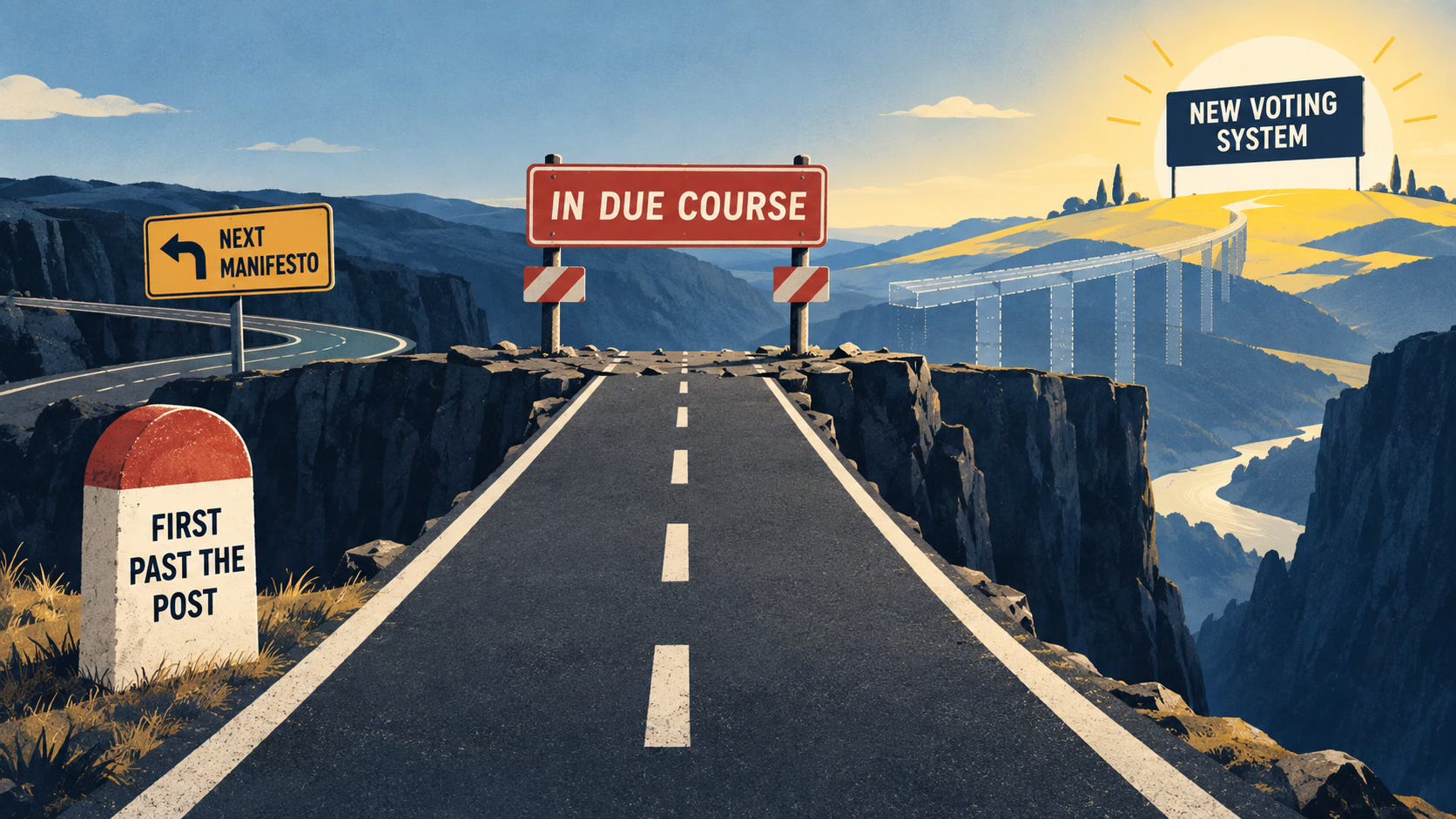
On Monday, Baroness Taylor opened the House of Lords debate on the Representation of the People Bill with a line worth holding on to.
She said it was a fundamental principle of democracy that every vote is equal to the votes of millionaires, crypto billionaires and industry magnates.
Money is one crucial part of that. Our last Ugly Politix piece called on the Government to use this Bill to cap donations and stop private wealth buying political influence unavailable to everyone else.
With Reform UK’s record-breaking £72 million arriving just before the debate, political money understandably dominated much of it.
Yet if every vote is supposed to be equal, the question does not end with who can afford to write the biggest cheque.
What happens when those votes reach the ballot box?
Baroness Smith of Llanfaes was one of the peers who highlighted the enormous voting-system-shaped hole in a Bill which deals with the Representation of People.
Baroness Lister backed calls for a National Commission on Electoral Reform.
Then Lord Teverson took the Minister’s opening principle about equal votes and followed it to its slightly uncomfortable conclusion.
He reminded the House that the 2024 election produced:
“A Labour Party in government with 411 Members of Parliament, a majority of 172, on an astounding proportion of one-third of the vote. Eight million people were missing from the register. Around 40% of registered voters did not turn out. Thousands were rejected at polling stations because they lacked the right ID. At least a quarter of those who did vote are estimated to have voted tactically rather than for the candidate they actually wanted.”
Lord Teverson welcomed the extension of the vote to 16 and 17-year-olds. He also asked the fairly obvious follow-up.
Will their votes actually count?
At present, where they live will have an enormous influence over the answer.
Lord Pack brought the argument together. First Past the Post was designed for a two-party system that no longer exists across much of the country. He wanted talk of a National Commission to turn into action.
By the end of the debate, the Government had clearly heard them.
We are finally in ‘when’, not ‘if’, territory
Closing the debate, Baroness Taylor said the Prime Minister is committed to bringing about a new voting system and welcomes a national debate about it.
She promised that the Government would set out a path in due course.
That is significant.
After years of campaigning, briefing MPs and peers and making the case for a National Commission, I would quite like to declare the job finished and spend some time lying on a beach.
I am delighted that we appear to have reached the point where the Government’s stated ambition is a new voting system. The conversation is moving from whether change should happen towards how and when it will happen.
That shift deserves to be welcomed.
Sadly, I am not packing the sun cream just yet.
“In due course” is an intention. It is not a timetable, a process or a roadmap.
The Government still has to explain how this national debate will happen, who will lead it, how voters will take part and how its conclusions will become something Parliament can act on.
There is also one fairly large problem sitting in the middle of its current position.
The manifesto catch
The Prime Minister has said that changing the voting system requires a mandate at the next general election.
That sounds perfectly sensible for about five seconds.
Then Lord Teverson’s figures come back into view.
The Government wants a manifesto commitment to provide a democratic mandate for replacing First Past the Post. That mandate would be awarded through an election run under First Past the Post.
We are asking the system whose fairness is in question to issue the permission slip for investigating it.
A party could win a huge parliamentary majority on one-third of the vote and call that a mandate. Millions of people may have voted tactically. Millions more may have supported parties offering similar reform commitments without those votes translating into many seats.
A general election also asks voters to choose between whole programmes for government. Nobody gets a separate ballot paper asking whether they support the voting-system paragraph on page 87 of a manifesto.
None of this makes an election result invalid. It does make a manifesto result a very blunt instrument for measuring public consent on the rules of the election itself.
The irony is difficult to miss.
We need to examine the voting system partly because First Past the Post fails to produce representation that accurately reflects how people voted. The Government’s current proposal is to use that same distorted translation of votes into seats as the test of whether reform has a legitimate mandate.
There is a better way to do this.
Build the mandate before writing the manifesto
A National Commission would allow the mandate to be built before parties make their manifesto commitments.
It would bring together independent commissioners, expert advisers and a representative Voters’ Forum. It would examine whether the current system still fairly reflects how people vote and, if not, what should replace it. The status quo would face the same test as every alternative. The Commission would also take that work beyond Westminster, driving a national debate as the evidence is gathered rather than presenting the public with a finished answer at the end.
The public would hear the evidence, test the arguments and help shape the conclusions. Parliament would receive a clear report. Political parties could then respond to those findings in their manifestos.
Voters would arrive at the next election knowing what had been recommended, why it had been recommended and what each party intended to do about it.
That would give the Government the electoral mandate it says it needs. It would also make that mandate far more informed, specific and legitimate than a promise produced behind closed doors and placed in a manifesto.
The Commission would not change the voting system. Parliament would still make that decision.
Its job would be to ensure that Parliament’s decision was built on something stronger than party interest and something more meaningful than counting seats produced by the system under review.
We have tried relying on the manifesto before
Anyone tempted to think a manifesto commitment means job done may wish to cast their mind back to 1997.
Labour entered that election promising an independent commission on voting systems.
It won a majority of 179.
The Jenkins Commission was established. It examined the options. It reported. No change happened.
First Past the Post had delivered Labour an enormous majority. Enthusiasm for changing the system that produced it somehow failed to survive the experience.
Starting the Commission now would make it much harder for electoral reform to disappear into another round of “later”.
Is the taskforce the path?
The Prime Minister has pointed towards a Cabinet Office democracy taskforce when asked about a National Commission. The Government has also described a cross-government task-and-finish team looking at political funding, illegitimate influence and broader threats to political equality.
Perhaps this is where the promised path will be designed.
At the moment, we do not know.
There are no published terms of reference, no membership and no timetable. The Government has not clearly said whether examining the voting system is part of its work.
If this taskforce will design the national debate, excellent. Tell us. Give it a timetable. Put citizens at its centre. Make sure its work can begin now and inform the next set of manifestos.
If it will not, the Government still needs a process capable of doing that job.
Peers have backed electoral reform. They have made the case for a National Commission. The Minister has confirmed an intention to bring about a new voting system and promised a path towards it.
That is progress. Real progress.
Now the Government has to turn intention into something voters can trust.
Let people examine the electoral system before they are asked to provide a mandate. Give parties an evidence-led basis for their manifesto commitments and give the next Parliament something credible to act on.
Then I will pack the beach bag.

Can a Broken Voting System Deliver a Mandate to Fix Itself?--NO-NO-NO
The Prime Minister has committed to bringing about a new voting system.
Now the Government must turn that promise into a credible path to change.
**
Not has long as U.K. elected Govt parties DO=NOT deliver fully what they
promise at G.E. and area council election in May 2027.
**
The U.K. OLD Govt parties Tory-Labour-Lib-Dem have all turned into puppets
for the rich private sector business people outside the U.K that fund their party
they running the U.K. NOW voters them in the E.U. not our elected Govt parties.
**
SO,-ANDY will you drop the Already Corrupted Devolution Deal in Lancashire areas
that is already being miss used by Cllr-Mayor alike and the rich private sector business
in Lancashire areas Now.
**
Tory-Labour-Lib-Dem we residents of Lancashire that have to Merge with other area
so the outcome of G.E. can be rigged by Govt party we public do not what your
A-C-Devolution Deal now its crap and will Not benefit our voters needs ANDY.