

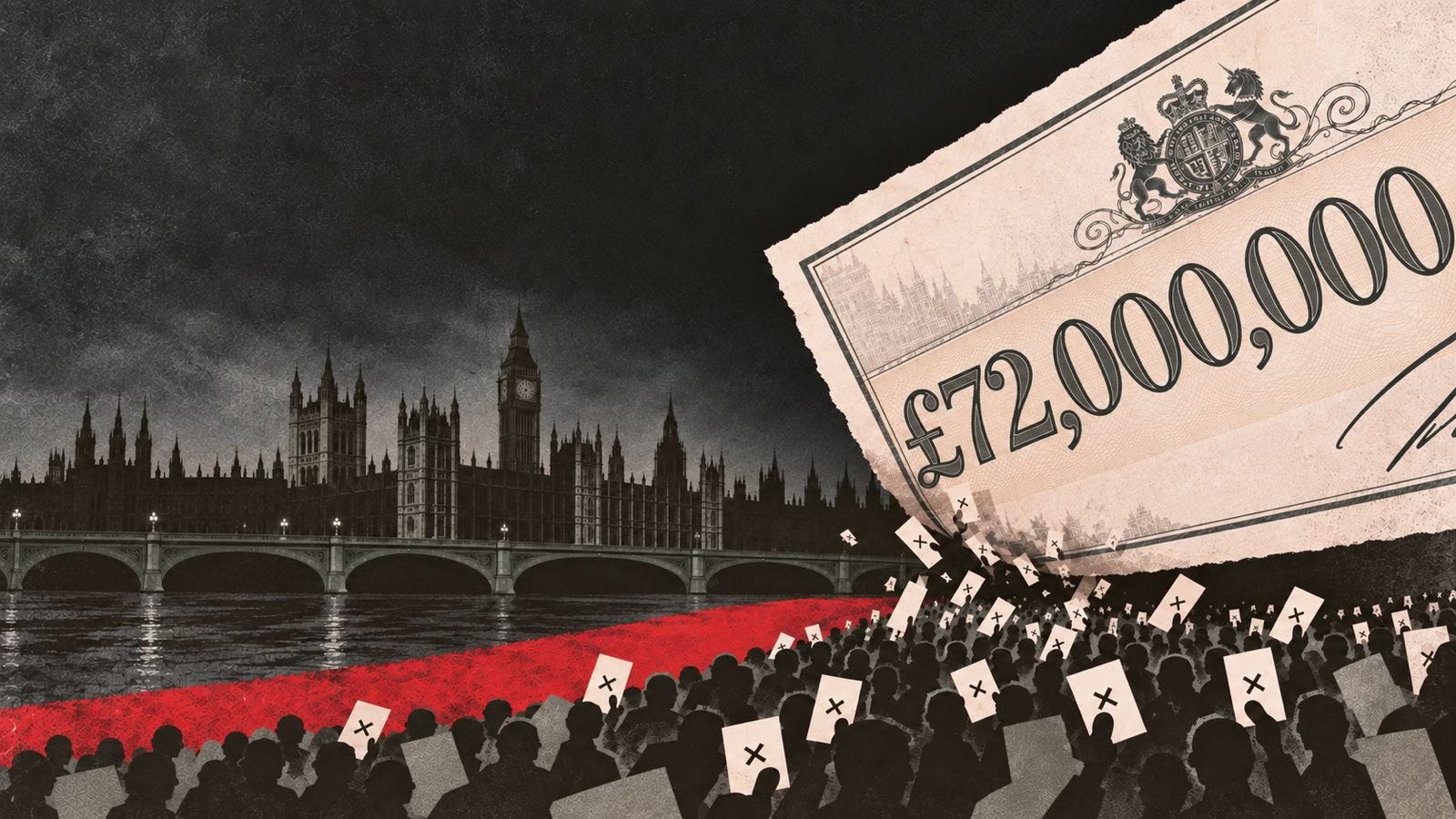
Last night, news broke that Reform UK had received £36 million from Ben Delo - the largest political donation in British history. Almost before most people had had a chance to process that, Christopher Harborne matched it. Within 48 hours, two men had handed one party £72 million.
That may not mean much to you without some context. So what does £72 million actually mean in British politics?
Compare it with what every party normally raises, what entire national campaigns spend and what the independent regulator, the Electoral Commission, has to oversee the whole system and its significance becomes much clearer.
It is more than every UK political party combined received in donations and public funds during the whole of 2025.
EACH donation is larger than the £35.1 million a party contesting every seat is permitted to spend nationally during the year before a general election.
It is more than twice the £32.6 million spent by ALL registered campaigners, on BOTH sides, during the Brexit referendum.
It is £17.2 million more than the amount the Electoral Commission spends each year keeping our electoral system fair.
It is hard to know what a wake-up call on money in politics would look like if it does not look like this.
Tomorrow, Open Britain will publish Money in Politics: In a Nutshell, our new plain-English guide to who pays for British politics, how the rules work, what Parliament has done in response to this issue, and what it has chosen to leave untouched.
We started writing it because we thought more people needed to be aware of this growing problem. Yesterday’s £36 million donation made it urgent. Today’s £72 million figure has made its central warning impossible to ignore.
If the latest headlines have left you asking how any one person can legally give a party so much money, and why our Government, when it had a chance to stop politics going down this route, did not take it - the report provides the answers.
Look out for it tomorrow. Read it. Share it. Put it in front of anyone who still thinks £72 million in 48 hours is a freak event rather than the predictable result of the rules we have chosen to keep. It is essential reading for anyone who wants to understand not only why this has happened, but how we stop it happening again.
Mega-donors are serious. Is the Government?
Less than two weeks ago, our Government had an opportunity to show that it was serious about tackling the scourge of money in politics.
Stella Creasy’s amendment to the Representation of the People Bill would have introduced a £500,000 cap, reduced over time. It was backed by 64 MPs from six parties.
The Government did not back it.
Instead, ministers kicked the issue into the long grass. They promised that a cross-government task-and-finish team would be assembled to find a solution to the “issue of mega-donors”. Right now, that task-and-finish team has no published terms of reference, no membership and no timetable.
The mega-donors, meanwhile, are certainly not forming a working group.
They are not waiting for terms of reference. They are not considering options. They are not promising to report at pace.
They are moving ahead. Fast. 72 million mph.
Why isn’t the Government as serious as they are?
This is bigger than Delo and Harborne
Neither donor is new to writing enormous cheques to Reform. Delo had already given the party £8 million this year - the latest donation takes his 2026 total to £44 million. Harborne was already Reform’s biggest donor and says he had been giving around £1 million a month before matching Delo’s record.
Regular Ugly Politix readers will know both names. We have already looked at their growing role in British politics, what motivates them and Reform’s increasingly cosy relationship with crypto.
All of that remains important. We could spend the next week debating what either man wants in return. We could hold every Reform policy up to the light looking for their fingerprints - and there will be plenty of time to do that.
Right now, we need to ask how our political system allows two billionaires this much influence over a party preparing for government.
Mega-donors who can pay for the staff, offices, polling, policy work, advertising and infrastructure of a party preparing for government do not need to slip a formal request across the table when they want something. Everyone at that table already knows. Because they will be thinking about it every minute of every day…because the continued support of those donors matters every minute of every day.
Donations of this magnitude make people important to a political party whether they ask to be or not. They make not annoying the benefactor the north star objective of the organisation, and make a loss of that benefactor’s confidence catastrophic.
It creates dependency, regardless of what that organisation’s leaders may choose to say in public.
The rest of us get one vote. We might sign a petition, write to our MP, join a party or spend a wet Saturday knocking on doors. We do not get a hold over the party’s finances. We are not in a position to direct the political machinery that decides which policies are developed and how decisions affecting millions of people (us!) are taken.
Whose voices are getting louder?
The Government introduced the Representation of the People Bill as a vehicle to modernise our democracy, create fairer and more inclusive elections and help millions more people make their voices heard.
Those are its words.
So where, exactly, are the “more voices” in this?
While millions of people get one vote each, one donor can hand a party more than it is legally allowed to spend on an entire national election campaign. Whose voice do you think that party is going to listen to first?
A democracy that allows private wealth to be converted into this kind of outsized political influence is neither fair nor inclusive. It is a system in which the rich and powerful can simply drown everyone else’s voice.
I work on democratic reform because I believe politics CAN be made fairer and more accountable. That requires a certain stubbornness. You have to believe the rules can change even after Westminster has spent years explaining why now is not quite the right time.
It is precisely stuff like this that has damaged my trust in politics. And I am not alone. Eighty-three per cent of people believe wealthy individuals use donations to influence government in their own interests. Only 14% think party funding and spending is transparent. Just 9% trust politicians to tell the truth.
The damage is compounded by watching a government acknowledge the problem, look at an amendment designed to tackle it and decline to act - only for the full horror of that problem to explode onto our screens ten days later.
The donor took the law at its word. The Government appears to hope the rest of us will share its enthusiasm for a task-force…one with no members, remit or timetable.
We should not.
One more chance
On Monday, the Representation of the People Bill begins its serious journey through the House of Lords.
The Government should not need another wake-up call. It should not need another decade of design work. The Electoral Commission has modelled caps at different levels. Parliament has seen workable proposals for phasing, aggregation, enforcement and the treatment of genuinely pooled trade union funds.
All that is missing is a government willing to decide.
The Government should put a comprehensive donations-cap framework into the Bill during its Lords stages. That framework should be robust, enforceable and designed to ensure parties are built on a broad base of public support. It should apply the same principle to concentrated wealth at home that the Government has already accepted for donors living abroad.
The mega-donors have shown us how serious they are.
On Monday, the Government gets another chance to show us that it is serious too.

History tells us that Emperor Nero fiddled while Rome burned. Is Prime Minister Burnham 'fiddling' while Farage lights the blue touch paper that will turn the UK into a far-right dictatorship?
When asked, if you could travel back in time, what would you do? The frequent response is, I would stop Hitler. Well, maybe someone from the future could do the honours with Nigel Farage. It is laudable that, in Britain, we offer a fair platform for all political debate and even the robust disagreements between parties are conducted in a generally civilised manner. However, Reform UK presents us with a situation that must not be underestimated. I am convinced that the general voting public have no idea what life would be like if Farage got into No.10. We would see the end of Human Rights, any hint of Equity, Diversity and Inclusion would be stamped out straight away. Unaccountable, unidentifiable, uniformed thugs would have the power to arrest those thought to be dissenters and mass deportations would be the norm. We generally accept that Trump is a deranged lunatic, but he is extremely dangerous and has already demolished a huge number of social safeguards within American society. Farage worships Him! Have we forgotten his threat to establish 'holding camps' in areas where voters had the audacity to vote against him? In the last few days we have seen masked thugs abusing RNLI staff who were helping people in danger on the sea. Those thugs are the sort of people who support Reform UK. They hide their identities and abuse the Union Jack, the Flag of St. George and the Christian Cross, and, they support a pure race theory and openly discriminate against people because of where they were born. I am I scaremongering? You bet! We need to be scared. The time for gentlemanly British political debate has passed. Farage is accumulating vast wealth which he will use to play dirty in any election; he has no respect for democracy whatsoever and if we vote him in we will pay a huge price, including our freedom of thought.
So, please Mr Burnham - don't just 'fiddle' - be bold in your fight against the far-right, call Farage out for what he is and do everything you can to enlighten Reform supporters; make sure they know exactly what type of genie they want to let out of the bottle.
Let's hope the Lords put the amendment on a £500,000 cap back into the Bill and when it returns to the Commons the Government back it and put a 3-line whip on Labour MPs to support it. Most other sensible Parties will back it too. Of course Reform will oppose it, but with only 8 MPs (and one of them perenially absent), they won't matter a jot.