

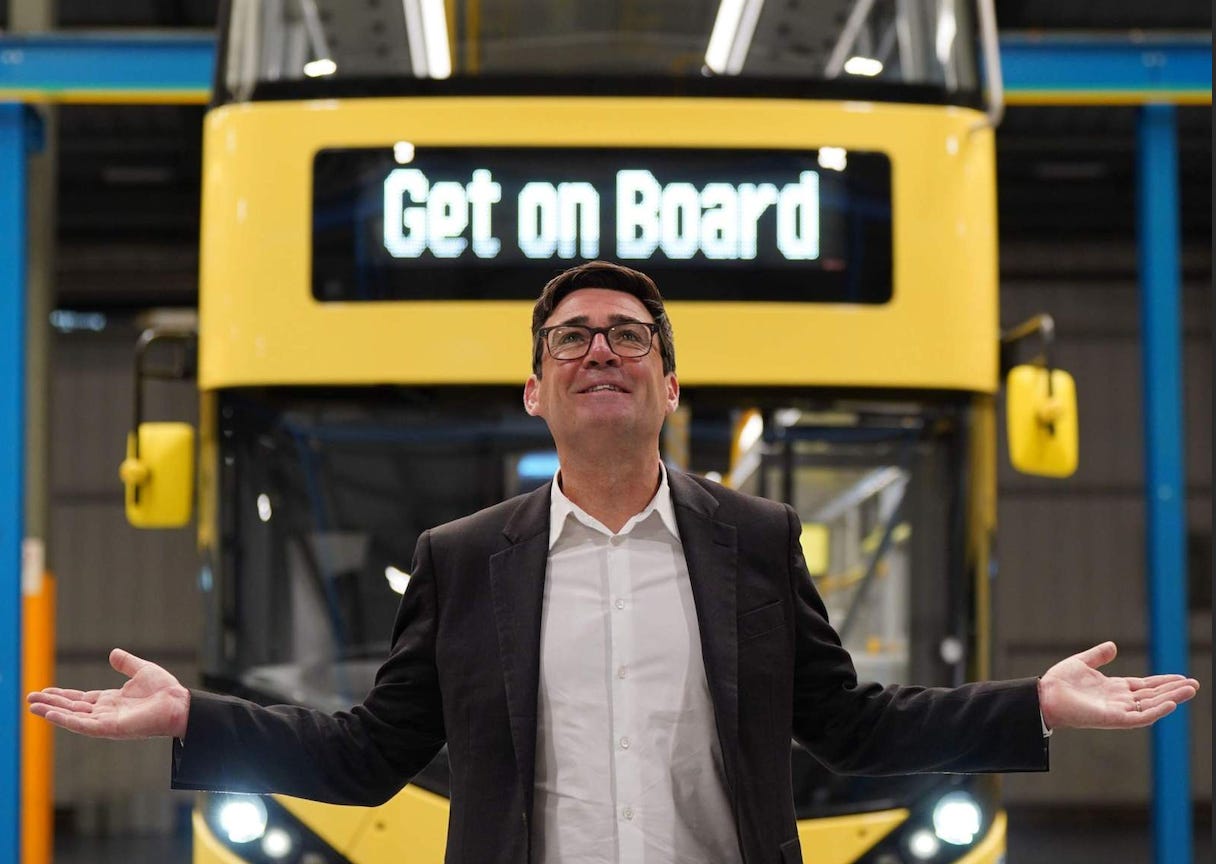
Andy Burnham, Labour’s candidate in the forthcoming Makerfield by-election, could conceivably be Britain’s next Prime Minister. The ‘King of the North’ has been Mayor of Greater Manchester since 2017 and, if he returns to Parliament next week, polls suggest he could emerge as a serious contender to replace Keir Starmer.
A former Labour leadership hopeful, Burnham has spent the past decade immersed in local politics. Unlike most senior politicians, he remains genuinely popular.
His return to the national stage has created a bit of a buzz amongst democracy advocates. Burnham positions himself against Britain’s Westminster-centric political culture, calling instead for “wholesale cultural change” in how the country is governed.
Sounds good. What does it mean?
Some clues can be found in Head North: A Rallying Cry for a More Equal Britain, the 2024 book he co-authored with Liverpool Mayor Steve Rotheram. Drawing on their experiences of Northern neglect and the legacy of Hillsborough, the pair advocate devolution, regional autonomy, an end to the party whip system, and a legal duty of candour for public authorities.
But as Burnham has become a plausible contender for the premiership, it is important to distinguish between the reforms he explicitly supports and those his admirers merely hope he might endorse.
It’s important to remember that Britain’s democratic problems run deeper than questions of devolution and parliamentary culture alone.
So what does Burnham actually stand for? I’ve taken a look at what we know – and what remains unclear – across four key areas: fair votes, democratic accountability, money in politics, disinformation and online harms.
Fair Votes
We’ll start with the good stuff. Burnham is a long-standing advocate for proportional representation, and he has even explicitly endorsed plans for a National Commission on Electoral Reform (NCER).
Burnham’s allies have said that he would use the NCER to determine the best electoral system for the UK and then seek a mandate to implement it. Burnham himself has indicated that his preferred route for securing that would be through a general election manifesto commitment.
Accountability
This is another strong area for Burnham. His previous proposals to ditch the party whip system could do a lot to restore trust – allowing MPs to not get sucked into the whims of Government and take more of a stand for their constituents.
But the big one here is the Hillsborough Law. Burnham is one of the legislation’s longest-standing champions – he’s long argued that officials and authorities must be held directly accountable for what they say. Currently, the Bill is in a bit of a Parliamentary quagmire, bogged down by disputes over carve-outs.
We can fairly safely presume Burnham will want the legislation in full force, given he’s spend decades campaigning on it and wrote a whole section of a book about it. It would be a massive step in changing the public’s disillusioned relationship with Government.
Dark Money and Influence
Now we get into hazier territory. Burnham’s broader mission suggests that he should be on board with getting wealthy, vested interests out of our political system. After all, it’s hard to have a place-based, decentralised and community-centred politics when politicians are doing the bidding of multinational giants or expat crypto billionaires.
We hadn’t heard much specifically from Burnham on this until this week. He revealed to a Byline Times reader that he did support placing a cap on donations. “This would guard against the perception of any one party being unduly influenced or swayed by one person or organisation,” he wrote. He claimed he would want to start with a higher cap and aim to reduce it over time.
If there’s going to be any point to a cap, it needs to be reasonably low. I’d also caution against the ‘we’ll get to it later’ logic that’s long plagued democracy reform in Britain. Burnham also hasn’t had much to say about the political lobbying system, leaving us relatively in the dark on what he’d do there.
Fair Information (Dis/Misinformation)
Burnham has spoken about the corrosive effects of mistrust and online political culture, though he has yet to articulate a detailed reform programme on disinformation comparable to his positions on devolution or constitutional reform.
Frankly, it’s not clear to me that he understands the scale of the digital threat we face. He’s called for the police to be faster in publishing information to avoid scenarios like the recent events in Belfast, Southampton, and Southport. But is that really going to stop a concerted, digitally driven incitement campaign?
Burnham has endorsed plans to ban under-16s from using social media. You may feel differently, but I think this gets it the wrong way around – adults are not immune to digital manipulation, and we should probably focus on going after the companies and their dodgy algorithms to make the whole thing better for everyone rather than building up more firewalls.
Burnham is currently the blank slate that a lot of people are casting their dreams and aspirations onto. He’s clearly got a lot of valuable things to say, and his focus on local solutions calls to mind that Zohran Mamdani-style politics that really invigorates people. A full-fledged Hillsborough Law is also clearly a good idea if we ever want to restore trust.
But we should remember that the system insulates itself against change. Part of the threat of democratic backsliding is that for every step back you take, the next step forward becomes twice as arduous. He’ll have his work cut out for him – the system will resist.
And to accomplish a true democratic revival in Britain, we’re going to need a comprehensive package. Every part must sing together in harmony, and they must be viewed as legitimate by the general public – lest the far-right exploit them.
It’s early doors yet, but Burnham has some blind spots to address if he wants to get serious about changing Westminster and the course of Britain.
If Andy Burnham can't be the man to push through the electoral reform needed, I honestly think there is no hope for any meaningful change (for the better) ahead.
The only changes in the future will be negative - as the Right will have stolen all the power, and they ain't gonna let that slip away once it's in their stranglehold.
Also, I don’t think he intends sanctions against Israel, so he won’t get my vote