

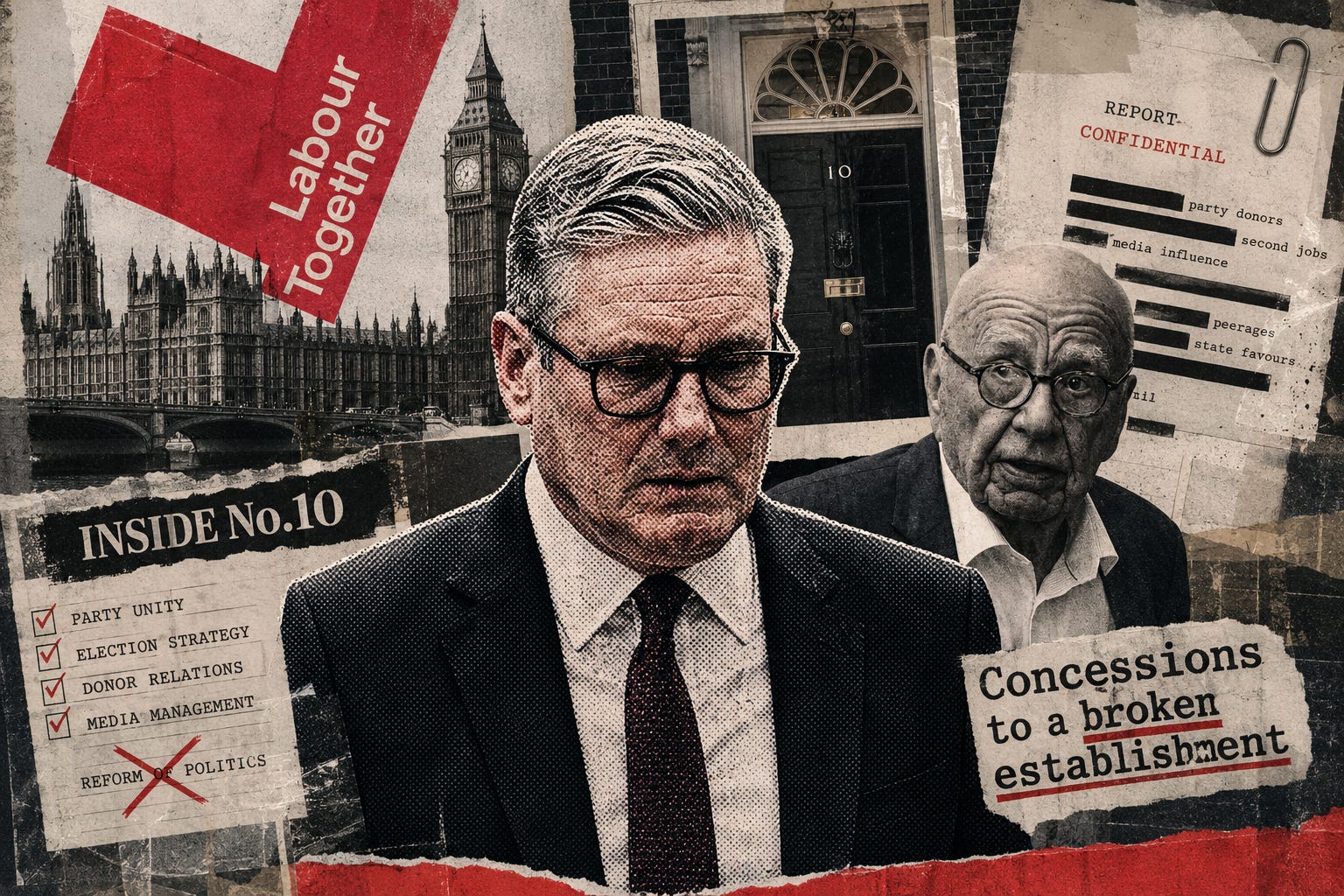
The role of Prime Minister in Britain today is starting to look a bit like a poisoned chalice. Over the past decade, six different leaders have taken the helm, and they’ve all wound up emotional at the resignation podium outside 10 Downing Street. We’re about to see how the seventh fares.
What happened this time? In a nutshell: like his predecessors, Keir Starmer didn’t have the mettle (or perhaps the inclination) to take on an utterly broken Westminster political machine. He tried to compromise with it. It undermined the public’s trust in him and made him historically unpopular.
Sir Keir Starmer’s Labour easily vanquished a beleaguered, directionless, and broadly loathed Conservative party in 2024. He made a grand promise to the country – one perhaps more difficult to fulfil than he realised. He told us he’d restore morality and principle to public life – that he’d put an end to a thirteen year cascade of corruption and chaos.
But it’s hard to be both principled and ruthlessly pragmatic. Starmer sought to win the game for a small faction of a political party – at all costs – within an existing Westminster framework. Whatever his intentions might have been, he didn’t treat the framework itself as the problem.
The extent to which Starmer shaped events - or was shaped by them - has been a recurring theme of his premiership. In Patrick Maguire and Gabriel Pogrund’s biography of the Prime Minister, Get In, they quote an unnamed member of Starmer’s inner circle. "Keir's not driving the train,” the source reportedly said. “He thinks he's driving the train, but we've sat him at the front of the DLR.” (Docklands Light Railway trains in London do not have drivers).
I imagine Starmer sees himself as a successor to the Blairite doctrine of ruthless political pragmatism. But when pragmatism meets a system defined by perverse incentives, principles often become negotiable. It’s easy to get inundated by the system itself.
Outside of a few stand-out exceptions like Votes at 16, Starmer never sought out the full democratic reset that we desperately need: campaign finance reform, strict lobbying rules, and electoral reform. Instead of taking on the system, he operated within its parameters.
Starmer was swept up by the Labour Together think-tank, the (dubious) mythology surrounding the strategist Morgan McSweeney, and the Atlanticist calculations of Peter Mandelson. He allowed himself to be courted heavily by the tech, finance, gambling and arms lobbies, as well as staunch pro-Israel groups that pushed hard against any action to alleviate suffering in Gaza.
He was subsumed by the frenetic logic of First-Past-The-Post elections – desperate to woo a specific subset of former Red Wall voters and unwilling to take the risk of offering them a bold new pitch. So he told his own voters “the door is open, and you can leave”, while embracing dark rhetoric on immigration that only served to lend credence to the elite insurgencies of right-wing populism.
And he was caught up, too, by the monopoly media. The Labour party has not denied that Starmer made a deal with Rupert Murdoch’s News UK to drop the crucial Leveson press inquiry in exchange for favourable coverage. A Labour source claimed the deal was “in the interests of the country” – because the ends, of course, justify the means.
While it’s true that Starmer was – especially towards the end – unfairly maligned by those papers on a number of nonsense non-issues, he was a major obstacle to enforcing accountability on them. In addition to breaking his pledge to never write for The Sun newspaper (he also repeatedly wrote for The Telegraph) Starmer hired the newspaper’s former editor David ‘The Dinosaur’ Dinsmore as a permanent private secretary for communications.
In essence, Starmer always assumed that trust was built by cold competence. His arithmetic never factored in that trust is built by congruence – by the visible, visceral alignment between what you say and what you do, between who you court and who you serve. You can’t reap the rewards of a broken system and expect not to face the consequences.
His compromises, taken cumulatively, told the public that his Government didn’t really believe strongly in anything at all. That might have played in the 1990s. But at a time when people are facing a lot of real, pressing problems, it cast him as a man for whom every red line had a shade of pink.
As Labour begins to look beyond Starmer, leadership frontrunner Andy Burnham says he wants to do things differently. If that's true, there's an easy way to prove it right off the bat. Do what Starmer wouldn’t (or couldn’t) do. Take on the system itself. Change the paradigm. Take control of that train and drive it to a better destination.
Start with donation caps to (actually) drain the swamp of money in politics. Establish a National Commission for Electoral Reform (NCER) to finally give Britain a credible, independent process for deciding how we elect our representatives. Overhaul lobbying so that access is transparent and strictly limited. Take social media giants to task for amplifying content that contributes to violence on our streets. Tell the Murdoch media it’s long past time they answered for their manipulations. And while you're at it, Andy, ban second jobs for MPs. Give Farage something to whinge about.
That’s how you get people’s trust back. That’s how you take the principled stand. That’s how you set yourself up for a bold agenda to address the real issues people care about. The last six PMs have folded to the perverse imperatives of a broken Westminster system. The seventh talks a big talk. Let’s see if he walks the walk.
Great piece. Misses out proper funding for political parties, as most do. When the fossil fuel lobby is trying to close down democracies political parties need equivalent resources.
Spot on, as usual 👌