

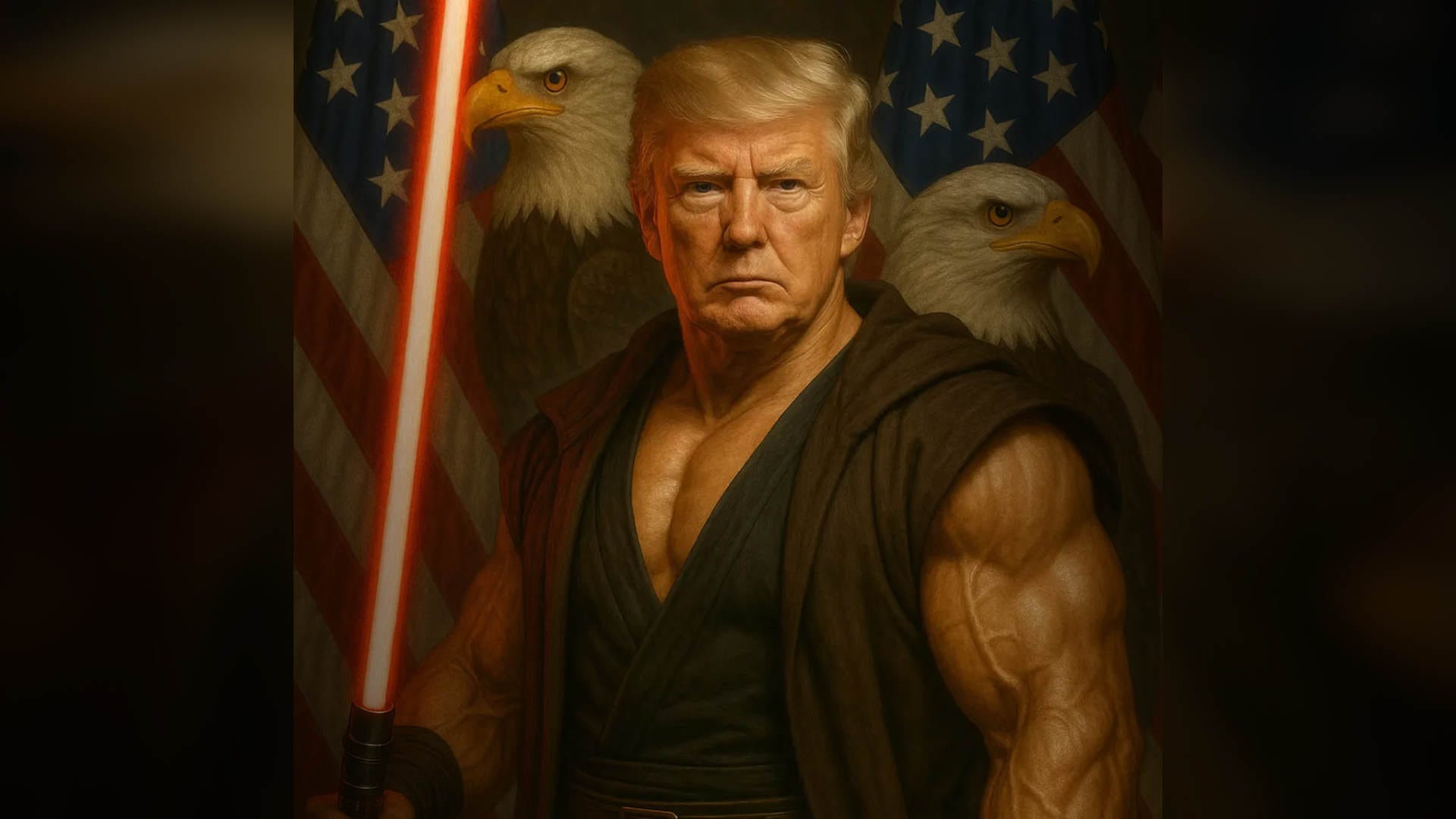
You might have noticed that the official social media channels of the United States government are posting like deranged basement-dwelling teenagers.
It doesn’t exactly breed confidence – in the midst of a highly consequential war – to see Nintendo Wii animations spliced with footage of lethal drone strikes. To watch bizarre montages of Iron Man, Braveheart’s William Wallace, and Top Gun’s Maverick calling you to arms. Or to witness AI-generated images of Trump riding into battle on a gigantic lion.
And yet this is what passes for political communication in 2026. The toxic and unthinking meme culture that was once restricted to dark corners of the anonymous internet has come to take on a central role in American public life. The term ‘slopaganda’ is apt: this is high-volume, high-engagement garbage – and it serves a clear strategic purpose.
There’s an obvious temptation to dismiss it all as a product of red-pilled Gen Z staffers. Or to say that it’s just the latest in the torrent of right-wing disinformation across the past decade. And those are fair points. But these videos and images serve a greater purpose – they trivialise and separate us from the realities of politics and of war. They stand in for real analysis and democratic debate, rendering people into bystanders rather than participants.
Trump’s political comms style was always more about emotional charge than informational substance. He’s the “sh*tposter-in-chief,” after all. The President’s infamous Twitter tirades gave way to early slopaganda during his first term. In 2017, Trump famously posted an old video of him tackling and punching out Vince McMahon at Wrestlemania, with “CNN” superimposed on McMahon’s head. However ridiculously, it set the tone: politics was presented as little more than a spectacle of conflict and humiliation.
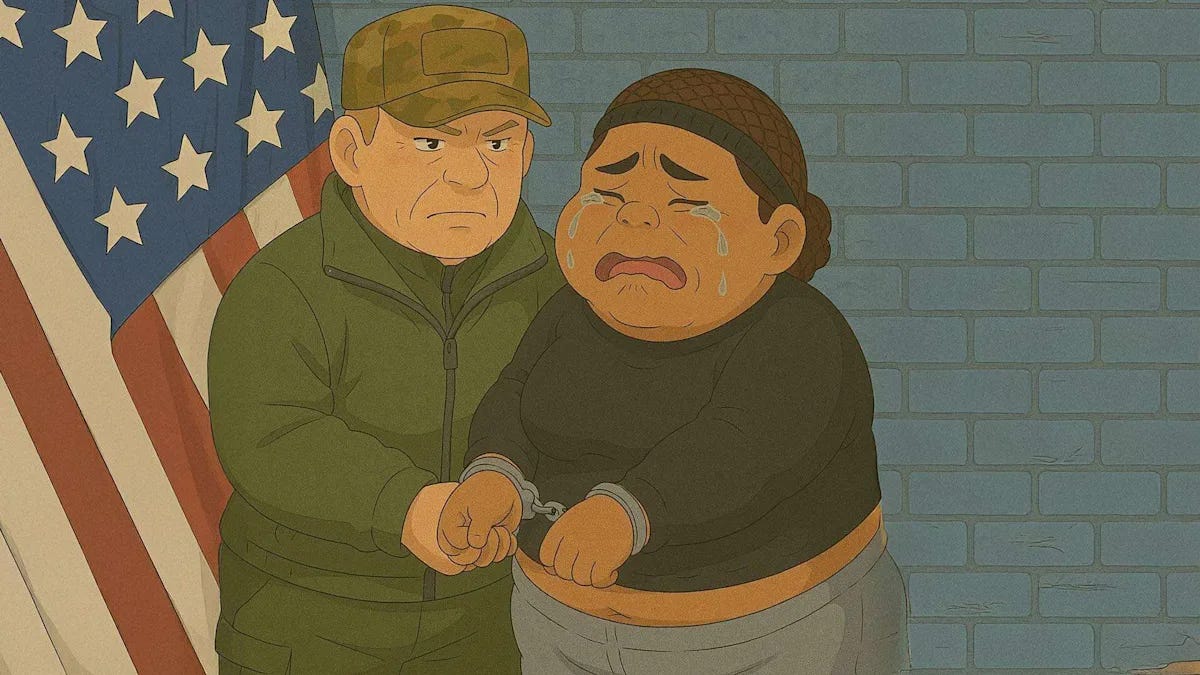
But with the heightened militancy and authoritarianism of Trump 2.0 – and the advent of AI image generation tech – we’ve plumbed fantastical new depths. The admin got in quickly on the Ghiblification craze last year (a viral trend where internet users fanatically converted images to the nostalgic hand-drawn style of Studio Ghibli films like Spirited Away). The White House posted a genuinely shocking image, mocking the deportation of a migrant in that same viral style.
And since Operation Epic Fury (the US and Israel’s controversial attack on Iran in late February this year) we’ve witnessed an explosion of AI-generated nonsense. People have lots of legitimate questions about this war – why it’s happening, how long it will last, what human and economic price will be paid. None of those questions are properly addressed by the administration, and the slop serves to shut them down entirely.
There’s a stark difference between this war and George W. Bush’s invasion of Iraq in 2003. At that time, the government had to craft a comprehensive narrative to justify what they were doing. They had to offer people a justification and a plan (never mind whether any of it held true) and at least take questions from critical journalists about it. The Trump administration can instead deflect entirely, jamming our feeds and our brains with trash content designed to light up his supporter’s brain chemistry and distract the rest of us.
AI models have given the Trump regime endless fodder for the media to mull over, as well as a way to capture citizens’ attention and detach them from the material reality of the conflict. This kind of content, as ludicrous as it is, is a honed weapon. It’s a form of information warfare designed to dumb down our political debates to utter oblivion.
We see much more mundane, diluted versions of this from the UK government as well. The Prime Minister has been accused of mimicking the White House after posting several videos of himself surveying military hardware – riding in helicopters and watching jets take off – set to the Dire Straits’ Money for Nothing. It was posted at the beginning of the US-Israel-Iran war. He’s previously posted a number of videos depicting his government’s detainment of undocumented migrants.
Where Starmer’s attempts are largely met with ridicule, the hard-right nationalists are Britain’s reigning Slopaganda champions. Reform UK, Rupert Lowe’s Restore UK, and the right-wing ecosystem around them have embraced AI imagery and videos for just about everything. In one dramatic case, Farage’s party posted an AI-generated image of the Hamble Valley Reform team entitled “Real People – Not Career Politicians.”
As in the States, the overarching goal is to simplify narratives. To build a fantasy world for supporters to abscond to. AI is deployed by the right to generate nostalgic and idyllic British towns before the supposed ravages of immigration, white faces as far as the eye can see. It shows fake images of Farage meeting a (non-existentent) terminally ill child as their dying wish. It portrays English knights making patriotic proclamations about blood and soil.
Joe Slater calls it “Zombie Politics” – the notion that parties like Farage’s and now Rupert Lowe’s can build themselves up from scratch (without much personnel or infrastructure) by leveraging these tools to go viral and cultivate attention. As he puts it: “An AI model can read a government data release, draft a response and circulate a press release before a legacy party has scheduled the meeting to discuss.”
But fundamentally what makes all of this so effective is not just the volume or the absurdity, but the tone. Online, everything exists in a kind of suspended ambiguity – a limbo of sincerity. It’s “irony poisoning”: a state in which constant exposure to this sardonic content erodes our ability to distinguish between what is meant and what is not. Politics begins to feel unreal, a pantomime to watch rather than a process to participate in.
This kind of content is invigorating to the small clique of right-wingers in Britain and the US looking for an AI fantasy world to inhabit. But more important is what it does to the rest of us: traps us further in a doom loop of political detachment, further and further away from true engagement and inclusion in our own political systems.
A democracy that is always reacting is not one that can truly act.
Inevitably, some of what's in this piece reminded me of the words of Hannah Arendt:
"The ideal subject of totalitarian rule is not the convinced Nazi or the convinced communist, but the people for whom the distinction between fact and fiction no longer holds."
“The creatures outside looked from pig to man, and from man to pig, and from pig to man again; but already it was impossible to say which was which.” 😬