

The United States today looks increasingly like the opening pages of a ham-fisted dystopian novel. The President has rarely seemed more volatile (which is really saying something), and there’s no end in sight to the blatant corruption and the ideological crackdowns of MAGA’s fanatical kleptocracy.
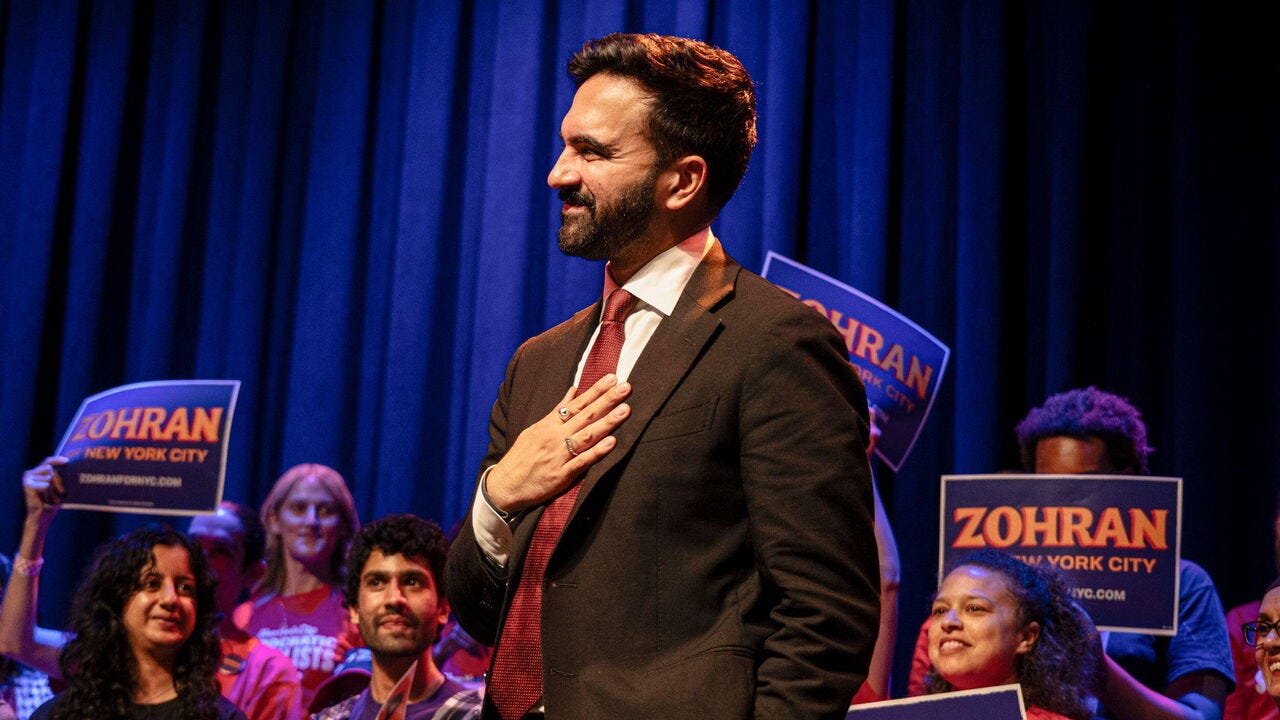
But in the pocket universe of Mayor Zohran Mamdani’s New York City, a subplot is unfolding to complement America’s tale of disruption and disorder. In the Big Apple, a different kind of political campaign won out against the odds last November. Mamdani just marked his first 100 days in office, his ambitious grassroots campaign now faced with the harsh machinery of New York City’s local government.
It certainly hasn’t all gone to plan. On the campaign trail, Mamdani emphasised the importance of a strong start, but budgetary constraints (a black hole left by the previous administration, familiar to us in Britain) have set him back significantly on his bold policy platform. New York City is still not affordable three months in, and Mamdani faces many roadblocks to implementing his core policies - free buses, freezing the rent, and universal childcare.
But it is revealing that Zohran Mamdani is currently the eighth most popular politician in the entire country, whereas the Democrats are suffering from their lowest approval rating on record - somehow trailing four points behind Trump’s Republicans.
So what can Mamdani’s first 100 days tell us about what voters actually want from politics now - and how hard it is to deliver it?
1. Politics Still Happens in the Real World
“New Yorkers deserve a mayor that they can see,” Mamdani told the camera in a viral video last June. “One that they can hear, that they can even yell at.” In that clip, the Mayor-to-be walked the entire 13 mile length of Manhattan island, a non-stop meet-and-greet with fans, critics, and oblivious bystanders alike. Last week, he did another long walk-and-talk to mark his first 100 days, embracing and chatting with his constituents.
While his campaign was lauded widely for its social media prowess, the content of those videos mattered. Where Trump will amass loads of views posting AI generated images of himself as a Jedi knight, Mamdani’s videos centre real people talking to their candidate about real (often quite local and niche) issues.
While you’ll see politicians like Trump and Farage have some success using the internet to amplify abstract national political narratives about immigration or cultural grievances, there’s something to be said for meeting people where they are. For reminding them that politics can start down their street instead of with a scroll of their phone. For being there for them to yell at you when you fail to deliver, instead of insulated and far removed.
2. Moral Clarity Cuts Through the Noise
Not unlike Sadiq Khan in London, Mamdani has faced a relentless barrage of vitriol from the right-wing press. His Muslim faith, his upbringing in Uganda, and his pro-Palestinian human rights position make him an obvious target. But despite the rogue’s gallery of influencers calling him a “terrorist” and an “Islamo-Marxist,” he continues to make a robust case for the benefits of multiculturalism and unity.
People see that and - even if they may disagree - have to respect it. Politics today is starved of conviction and moral clarity, so contorted by the whims of donors, consultants and lobbyists that it’s very hard to believe what anyone is saying. Refusing to yield to the powers that be is a sort of superpower.
When asked about Trump’s Iran War recently, Mamdani did not mince words: “We are spending tens of billions of dollars to kill people. Money that could be making life easier for working people.” You’d struggle to imagine most other American politicians saying that.
3. Hope Isn’t Cheap
Mamdani’s movement, at its core, is about hope. That multicultural democracy can win out over the xenophobes and the racists. That a new social and economic contract can help squeezed families pay their bills. That people can trust politics again.
But the harsh realities of the first hundred days have made clear that hope alone isn’t really enough. To survive contact with budgets, roadblocks, and the slow grind of government requires a great deal of graft and pragmatism.
The author Ta-Nehisi Coates observed recently that different kinds of communication come at different costs. Farage and Trump can “talk on the cheap,” as he puts it, throwing words out into the world and getting just enough back to build hollow and insincere movements.
But where shooting out a tweet is cheap, “it’s significantly more expensive - mostly in time - to cook dinner for somebody, to travel to a city to see somebody, to organise a group of people to see each other,” Coates writes. To build a movement in the real world.
Mamdani’s 13-mile walks, his unscripted encounters, his willingness to be yelled at - that is expensive work. It doesn’t go viral as easily as mass-produced AI slop. It doesn’t produce a quick return on investment. And after 100 days, it hasn’t yet delivered an affordable New York.
But Coates’ takeaway is that you get what you pay for. Cheap messages produce a cheap product - movements that evaporate upon contact with reality. The hard work of getting people together produces something slower, harder, and more durable: a reservoir of goodwill that might just survive the first 100 days, and the next 100 after that.
Now that is truly inspirational, thank you for sharing that. Cheap talk with cheap effects v slow demanding engagement with slow but lasting societal impact.
Apart from Manchester/London how many names can you count that talk freely to real issues and share their open views, irrespective of whether popular or mainstream correct.
A politicians master-class!
Mamdani is taking serious risk when strolling about to meet people in the streets. It only takes one MAGA twit with a gun to take him out. My sincere respect to this man and I hope he finds a way to succeed.