

FAIR WARNING: This is an unusually long Ugly Politix piece. If you’re not the type who enjoys reading 2000 words - I’m looking at YOU, Mr Somerton! 😉 - you might want to skip this one. No offence will be taken.
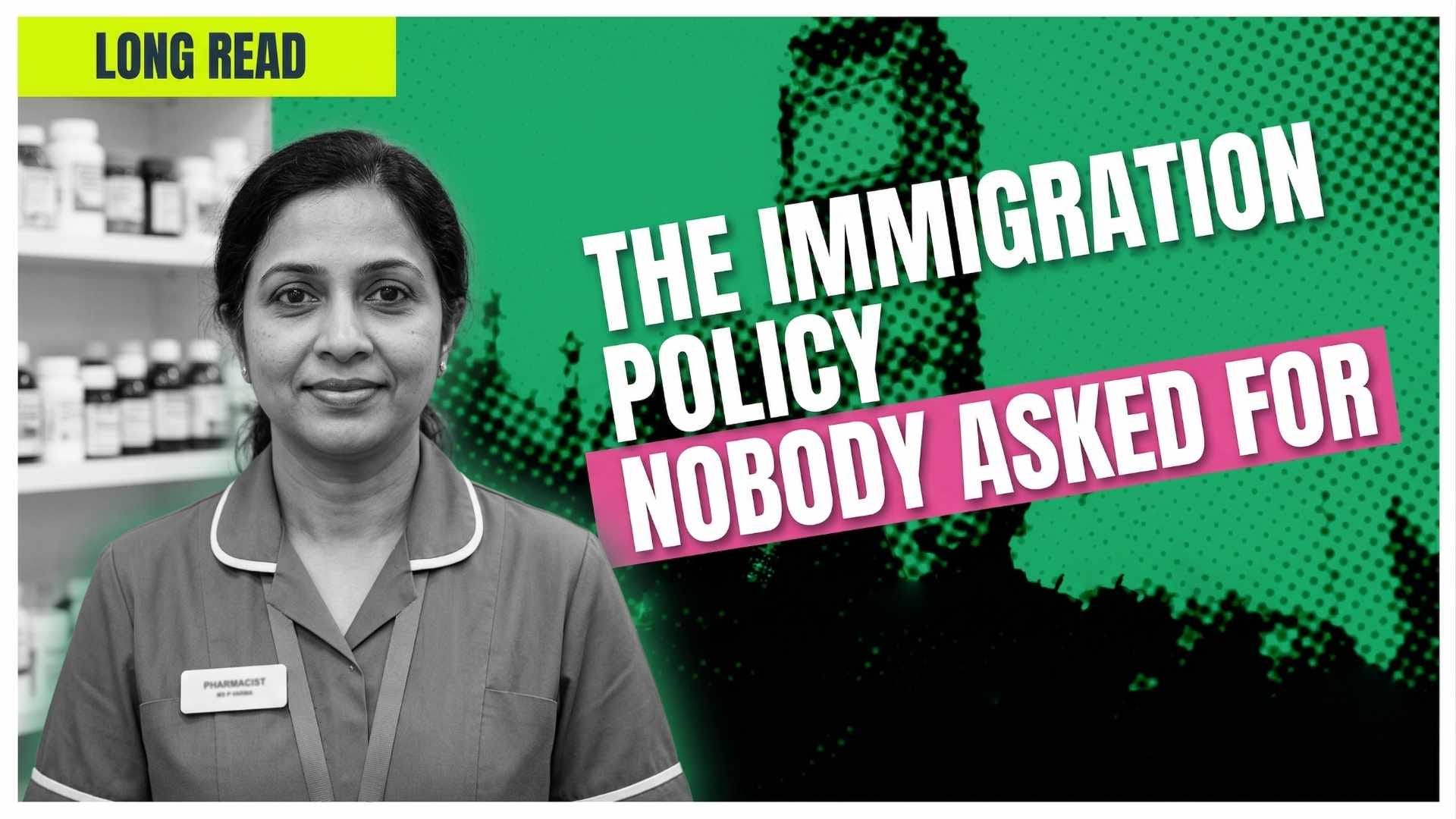
I was in a chemist in Grantham the other day, and got talking to the pharmacist dispensing my prescription. It is one of the blessings of my Irish stock that I am predisposed to strike up conversations with strangers - something I have always done and something I always will. Why? Because I have lost count of the number of magical moments this habit has given rise to over the years - moments of laughter, of insight, or just of genuine and unexpected human connection. And, on this occasion, it was all three.
You see, as well as being both funny and clever, the woman behind the counter was from Kerala. She had been in the UK eleven years, was able to address her regular customers by name, and - perhaps most importantly - knew precisely what pills and potions they needed to keep them ticking. It was clear from the few moments I spent in her presence that she was part of the fabric of the place - part of Grantham - and an important part of the lives of those regulars.
I mention her because, increasingly in this country, she and people like her are seen not as essential components of our communities but - to adopt the tone of the government’s recent Immigration white paper - a fiscal liability.
Don’t worry, loyal readers, I am not about to conduct a forensic exploration of that immigration white paper. I just think that this little exchange between two strangers tells us something important - and I want to make sure you don’t miss it.
The revelation is not so much about immigration but about how political decisions are made in our country. And that, as you will know, is the subject behind virtually everything I do in my day job running Open Britain.
Let me start by asking you to ponder three statistics: 62% of the British public want it to be easier for NHS staff to come to this country. 54% say the same for care workers. And only 8% oppose immigration for skilled workers. Those are not statistics from some overly-woke pressure group with an agenda - they are the settled, repeated findings of mainstream polling. The British people, it turns out, have much more sophisticated views on immigration than they are generally given credit for.
Now let me tell you what the government is planning to do. It is planning to shut the care worker visa route entirely to new overseas recruits - a route through which more than 220,000 of these key workers have entered the country since 2020. It has already hiked the salary threshold to £41,700, and now plans to raise it further - and it intends to scrap the ‘shortage occupation list’ discount on that threshold. It plans to raise the minimum skill level to degree-equivalent, which removes roughly 180 occupations from eligibility at a stroke. And it intends to double the qualifying period for permanent settlement from five years to ten.
You might read that list and think: well, the public must have been clamouring for all of that. They were not. In fact, despite the impression given by our media, immigration is not even in the top ten topics when people are asked about their own personal priorities - the things that actually keep them up at night. It only surges into the list of top issues when pollsters ask a different question: what are the country’s priorities? That gap - between what people experience in their own lives and what they believe the nation is suffering from - is largely the product of a cynical process known as agenda-setting. It starts with certain politicians and media outlets deciding what crisis suits their needs. It involves them flooding the airwaves with exaggerated and skewed ‘news’ that drives concern in their audience. And it ensures people dutifully report it back to the pollsters as a key concern when asked a carefully framed question. Public sentiment is reduced to a pawn in the games of billionaire media owners and political power-brokers.
It’s important to point out that people do have genuine anxieties about certain aspects of immigration. They worry about irregular small-boat crossings and the lack of control that signals. They worry that dangerous individuals convicted of crimes and deported can find their way back into the UK. But they don’t worry about the Filipino nurse keeping a ward running at three in the morning, or the healthcare assistant doing observations at four. Those people are, by any honest reckoning, holding the country’s healthcare system together. And we have a dangerous lack of those people. There are 131,000 unfilled social care vacancies in England right now. 34,000 nursing gaps. UNISON has said bluntly that these sectors would have collapsed long ago without overseas workers.
And, knowing all this, the government’s considered response is to slam the door shut on this essential resource. Why?
Home Secretary Shabana Mahmood exposed the government’s reasoning, and it’s worth pausing on, because the framing tells you everything about the thinking behind it. She warned of “350,000 low-skilled workers and dependents” with an “estimated lifetime cost to the taxpayer of £10 billion.” Now, leave aside whether those numbers survive scrutiny and just notice what that framing does. It takes a quarter of a million individual human contributions - the carer who gets your elderly mum out of bed in the morning, the HCA who ensures the nursing home is safe and hygienic - and it compresses them into a line on a spreadsheet. A cost. A burden. Something to be managed down.
Labour MP Tony Vaughan, to his credit, put his finger on the sharpest absurdity. Under the new rules, he pointed out, a Goldman Sachs banker on a senior intra-company visa can reach indefinite leave to remain years before the care worker in that nursing home. “We cannot have a system,” he said, “where the child of a banker gets settlement after three years and the child of a care worker gets it after 15.”
And the damage is not limited to the individual. Industry analysis suggests the reforms could cost their employers upwards of £14,250 per worker in red-tape costs before permanent residence - a reported 158% increase. For the social care sector, which operates on margins that would embarrass a church fête, those numbers are not a challenge, they are an extinction event.
So - and this is the question I kept coming back to - if the British people don’t want this, and the evidence doesn’t support it, and the sectors affected are already in crisis, then who exactly is it for?
And here is where we leave immigration behind and arrive at the thing I actually wanted to talk to you about.
It is for the swing voter in the marginal seat. Or rather - and this is an important distinction - it is for the government’s idea of what that swing voter wants. An idea shaped not by data, not by evidence, not by the 62% who’d like the NHS to be able to recruit the staff it needs, but by the distortion machine that is the first-past-the-post voting system.
You are probably all sick of me telling you that Labour won 63% of the seats in the House of Commons on 34% of the vote at the last election…but it’s an important factor in all this. That is not a mandate. It is a quirk of the distortion that FPTP brings. And it creates a very particular kind of terror for the government - the terror of the accidental majority. When your grip on power is built on sand, you do not govern for the country. You govern for the few thousand voters in a few hundred constituencies who might tip the result in your opponents favour next time. You govern for the margin.
And who is in the margin right now? Reform UK - the party projected to win 381 seats on 31 per cent of the vote at the next election. But only 6% of Reform voters believe Starmer is genuinely anti-immigration (and so are unlikely ever to put their votes behind him on that basis). The government is chasing voters it will never catch, using policies that punish people it claims to represent, justifying their actions with a popular mandate it does not hold.
This is the chaos and distortion that FPTP brings. 74% of votes cast - 21 million of them - are wasted (ignored) in the process FPTP uses to translate the will of the people into the power structure within the Commons. This is why the views of the 62% who want skilled immigration made easier end up being ignored. Because their votes aren’t in the right postcode, their views don’t matter.
Some MPs have decided not to accept the chaos and distortion, at least in this one area of policy. A hundred Labour MPs signed a letter opposing these particular reforms. Angela Rayner went so far as to call them “un-British.” The government reportedly asked the Home Office to consider the options - but the official response was that “the position has not changed.”
Here is what should strike you most powerfully in all this. It is that first-past-the-post doesn’t merely distort who gets to sit in parliament, it distorts what they do when they get there. It takes a nuanced public position that is broadly pragmatic about immigration - yes to nurses, yes to scientists, worried about disorder at the border, not remotely interested in punishing care workers - and compresses it into a single, panicked imperative: ACT TOUGH. And so governments - of whatever colour - ARE tough. On the wrong people. In the wrong way. Every time.
Under proportional representation - I know those words make some people’s eyes glaze over, but stay with me - a government would find it much harder to push a programme that didn’t reflect what the country actually thinks. It would be as unlikely that it could push an agenda of open borders as it would an agenda of forced deportation of settled immigrants. Its line of least resistance would be in pursuing an agenda for which there was broad public support and for which there was fair representation in the Commons. In this case, it would increase the likelihood that they would implement policies helpful to a care sector needing to recruit the staff it needs. It would mean an immigration system designed around evidence rather than headline management. It would mean the 62% who want NHS recruitment to work would have a parliament that looked like them, and policy that sounded like them. It would be proper democracy.
The British public already knows what it wants on immigration. It has been remarkably clear about it to anyone willing to listen. The problem is not the public. The problem is a voting system that takes a nuanced public opinion and turns it into a blunt instrument, then hands that instrument to whichever party can secure the support of the biggest minority of voters.
I didn’t ask the woman in the chemists what she thought of the government’s immigration plans, but I suspect she’d see the gap between what the people she serves actually want and what they end up being offered more clearly than most.
A change in our electoral system wouldn’t solve all these issues overnight. But it would force every government to engage with what people actually think, rather than what it is convenient to pretend they think. And that, for me, is the minimum a democracy owes its voters.

And so we see as well why the UK will never get anything truly substantial when attempting to ‘reset’ the relationship with the EU. Brussels is very well aware that FPTP enables any ‘new’ UK minority government to undo whatever they agreed with the previous minority government. They’re sick of it. What an achievement!
Thank you Mark for keeping on keeping on. I started working with Homeless people in Southampton in 1976 moving on to work in partnership with the NHS to provide their patients with good quality housing instead of hospital beds.
So, in succeeding decades I have seen, from the inside, how essential workers from abroad have been to both the functioning of the NHS and the housing and rehabilitation of so many of our poor English patients have been!
This is a huge untold story which I am only able to hint at because I do not have the intellectual resources, at present, to devote to it.
The fact that, I see, every day, my neighbours needs being met by workers who might be labelled as 'immigrants' or that I had my physiotherapy programme devised by another, just last week, shows you how dependent we are as a nation on the toil of others from overseas.
And I am just a poor English boy from Bristol which was an immigrant city before I was born back in the Forties.