

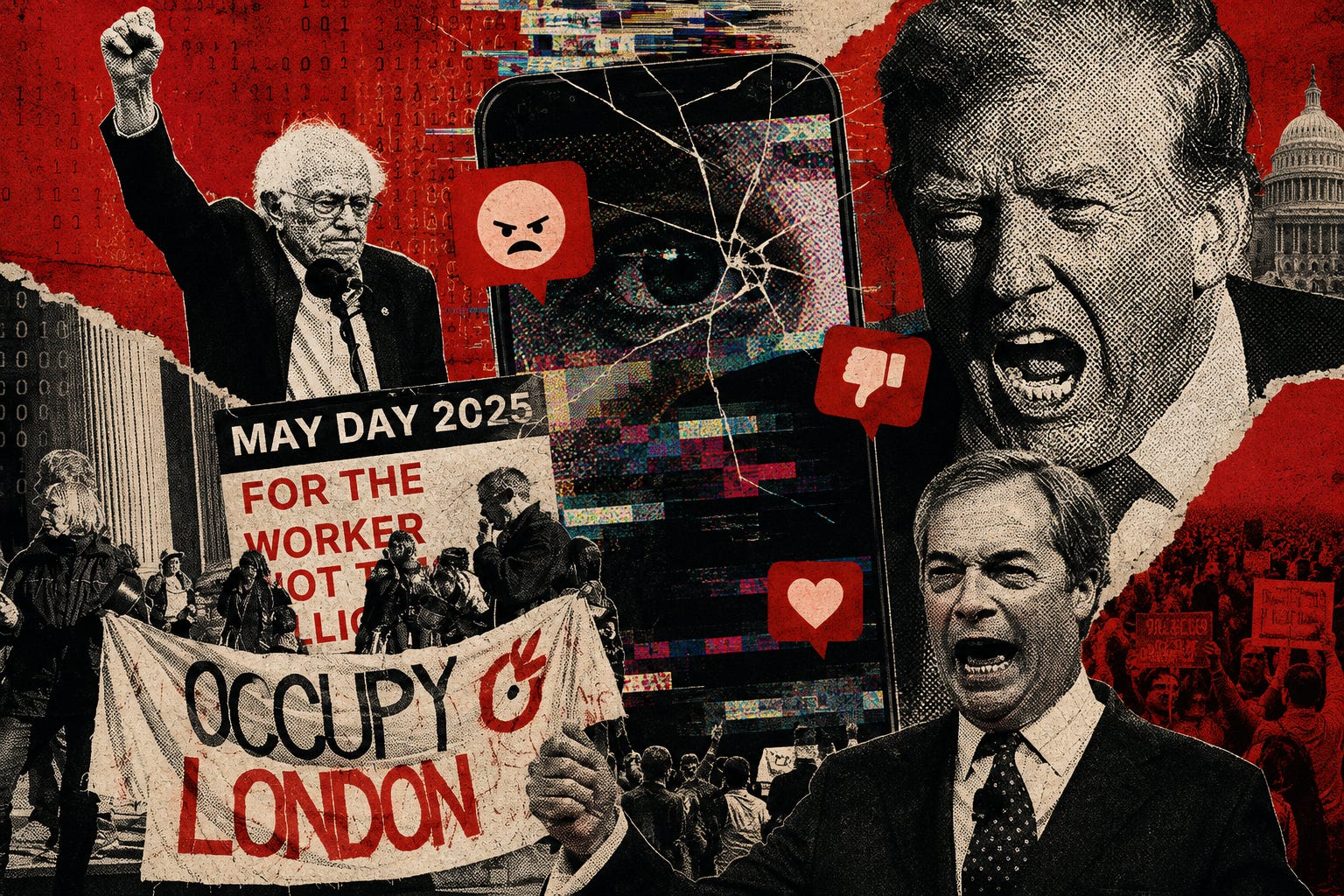
The key paradox of today’s politics is this: people are incredibly passionate, vocal and engaged, but our efforts to create lasting change seem to evaporate on contact with reality. As historian Anton Jäger has put it: we are slamming the accelerator with no petrol in the tank.
His new book, Hyperpolitics: Extreme Politicisation Without Political Consequences, offers a compelling diagnosis. The institutions that once channelled our political energies – mass parties, trade unions, churches, civic associations – have steadily withered. (I do think his book romanticises these often prejudiced and hierarchical organisations a bit – but the point stands that there used to be stronger bonds between civic, social and political life).
The prosperous, depoliticised “end of history” that began in the 1990s, and accompanied the erosion of these social bonds, was shattered by the 2008 financial crisis. People returned to politics in the late 2000s with a vengeance. But no one rebuilt the collective institutions that once channelled passion into power. Instead, we tried to replace them with the internet.
The result has been what Jäger calls “hyperpolitics”: a society saturated with political fervour, protest, and extreme polarisation, but increasingly confined to an algorithmic realm of fleeting outrage.
It seems naive now to think the internet could truly replace mass organisations. But we forget how strong that promise of digital democracy was – the promise of unprecedented new horizons of human connectivity. Instead – thanks to the Elon Musks and Mark Zuckerbergs of this world – we got echo chambers. A historic level of political balkanisation, a fragmented series of identity clusters, each screaming into its own algorithmic void.
The main beneficiaries of hyperpolitics have been the populist right. They figured out early (think back to Brexit and Cambridge Analytica) that grievance, division, and outrage could be gamed and monetised. Deploying simple catch-all slogans (“Make America Great Again,” “Take Back Control”), backed by mega-donor cash and troves of personal browsing data, they cobbled disparate groups together into coalitions that stuck together just long enough to win elections.
They continue to farm agitation: outrage over Black characters in The Odyssey, a trans person in a Bud Light advert, or manufactured panic about migrants eating swans. But as Trump’s second term demonstrates, their popularity stumbles once they attain power and routinely prioritise the interests of wealthy donors over their constituents.
The centre of politics, meanwhile, is struggling globally. Figures like Morgan McSweeney – Keir Starmer’s former Chief of Staff – remain wedded to a model that, as Jäger puts it, “treat[s] the electorate like a black box from which one hopes to extract insight after a plane crash.” Rather than rebuild relationships, they study an increasingly fragmented electorate from above: polling, focus-grouping, and segmenting it into ever-finer demographic slices.
This triangulation is the strategy of political actors with little to say. In an era of stagnant wages, soaring inequality, and crumbling public services, technocratic “evidence-based policy” is not speaking to people’s genuine frustrations.
That leaves the left, which has repeatedly mistaken online mobilisation for organisation. Various movements have created “repertoires of social expression that require little to no long-term obligation”: viral campaigns on Instagram, flash-in-the-pan mass protests and insurgent movements. From Occupy to Corbynism, the left has repeatedly demonstrated its ability to mobilise enormous numbers – often composed of young people – but has struggled to turn that mass energy into any kind of durable power bloc (despite often openly stating their intention to do so).
So where do we go from here?
There are obvious places to start. Getting big money and revolving-door lobbyists out of politics would force parties to cultivate members rather than mega-donors. And ending First-Past-the-Post would stop parties ignoring millions of voters while obsessively polling a handful of swing seats.
But none of this, on its own, rebuilds the collective life Jäger describes. To truly revive the mass politics of the 20th century, Jäger says, is like “the genomic reconstruction of a mammoth from DNA samples extracted out of the Siberian permafrost.”
All he has to say about the prospect of renewal, somewhat disappointingly, is that it will emerge in “everyday life” – in places where people communicate and express “common concern.”
But seeing as civil society and much of the economy have now gone digital, I do wonder if one such place could still be the internet. If only we could find a way to fulfil that original digital promise of meaningful and consequential connection, to break down the barriers of our echo chambers, liberate people from Big Tech’s walled gardens, and build systems that facilitate association, mass cooperation and healthy political competition.
The tools, as far as I can tell, exist: encryption, open-source software, interoperable networks, community-owned platforms and digital systems for deliberation and participatory decision-making.
Today’s billionaire-owned internet is designed to turn our fleeting attention into massive profits. Not to turn our connections into binding political associations.
It’s quite hard to envision a different kind of web, and the power-mad tech bros certainly wouldn’t welcome that act of imagination. There are plenty of questions that neither Jäger nor I can yet answer about what it would actually look like.
But if the thesis of Hyperpolitics holds true, perhaps that’s the place (beyond the obvious, immediately actionable regulatory reforms) where those of us who care about the future of democracy should start looking.
Another interesting analysis. It is true that anger is a powerful way of drawing attention, especially that of those with a limited attention span. The far-right employs 'shouty' people for this very reason; Trump and Farage being the perfect examples. Sound bites tinged with anger, such as "Stop The Boats" will fire up the juices of the less intelligent whereas, "Be Nice To Everybody" would be dismissed as woke nonsense. How the left fights back is a tricky one because their rationale requires some thought and reason, as well as an informed approach to social politics. It also involves caring about people beyond yourself and your cronies, seeing a bigger picture, looking to the future - all things that are not in the far-right play book. On top of the noise of the far-right, we also get the disinformation and downright lies, especially via social media, which is generally owned and controlled by - the far-right, of course. At this point, I would love to be able to provide a wise solution, but I am unable to do so. As a retired teacher, all I can say is that, among the many challenges in the education of young people, critical thinking should be encouraged at every opportunity; take nothing at face value, especially if it comes in the form of a news headline or a three word slogan.
The term 'hyperpolitics' reminds me of the term 'hypernormalisation'. A term coined by the Soviet era professor of anthropology, Alexei Yurchak, who was born in Leningrad and later went on to teach at the University of California, Berkeley. He introduced the word in his book "Everything Was Forever, Until It Was No More: The Last Soviet Generation" (2006), which describes paradoxes of Soviet life during the 1970s and 1980s. In it he says everyone in the Soviet Union knew the Communist system was failing, but no one could imagine any alternative to the status quo, and politicians and citizens alike were resigned to maintaining the pretence of a functioning society. Over time, the mass delusion became a self-fulfilling prophecy, with everyone accepting it as the new norm rather than pretend, an effect Yurchak termed hypernormalisation. Adam Curtis, British documentary filmmaker, wrote and directed a film of the same name in 2016 (HyperNormalisation). In his film, he argues that in the West, the global economic crises of the 1970s, led governments, financiers and technological utopians to give up on trying to shape the complex "real world" and instead establish a simpler "fake world" for the benefit of multi-national corporations that is kept stable by neoliberal governments. Hypernormalisation and its offspring hyperpolitics have since gained further resonance and strength in the social media era of the 21st Century.
Since the late 1970s/early 1980s mass party politics, trade unions, civic associations and churches/religious life have been eroded by the growing strength of neo-liberalism and the effects of hypernormalisation. Society has turned inwards, as people have focused more on self, "what's in it for me", rather than the common good when faced with the complexities of the real world. The brave, hope-filled, new world of the post Second World War years has been lost in the greed and lies of neo-liberalism as Western old colonial powers and the US have tried to manipulate the world for the benefit of large corporations and those of extreme wealth. Large corporations have been joined by the tech-multibillionaires as they have rode the whirlwind of hypernormalisation and turbo-charged the demise of mass party politics, civil society and trade unions as people have retreated online to air their grievances and shout at each other instead of encountering each other in true dialogue/discussion.
For me the only solution is to start from the bottom up. Grass root organisations such as Open Britain, politicians born in or having lived in communities for many years which they represent, thus having the interests of those communities close to their heart instead of those of lobbyists or wealthy donors, and young people educated in the traps and misinformation/disinformation flooding social media. Political party funding should come from membership fees and the public purse for election campaigns. There should be no private money in politics and politicians shouldn't have second jobs. If they are allowed to work it should only be for short periods in the major parliamentary recesses. A better world is possible but it ain't no walk in the park.