

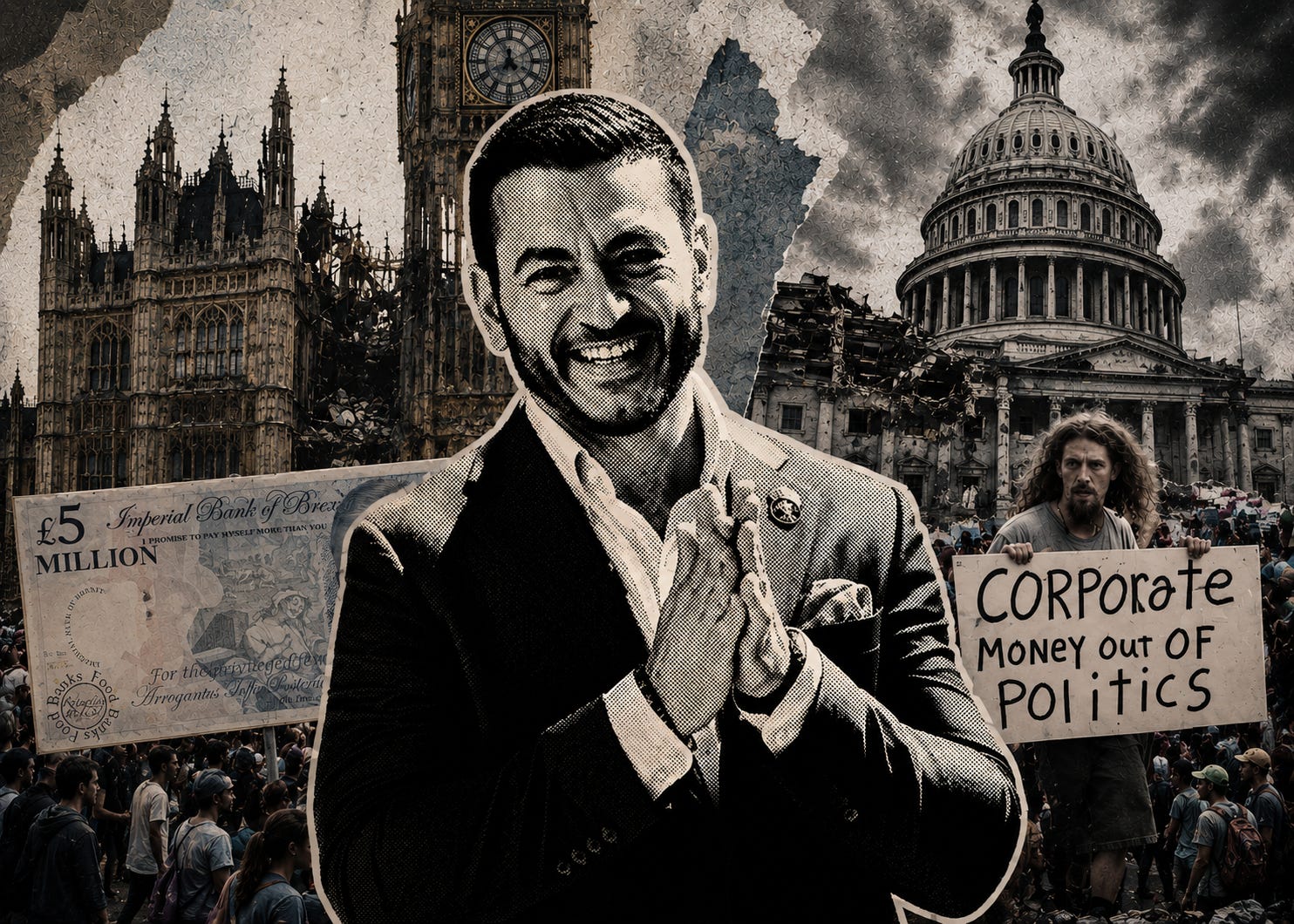
Politicians defending money in politics often sound the same. Rarely do they make the case that our system is in any way improved by massive and growing influxes of donor cash. Instead, they lament the campaign-finance-industrial-complex as an unfortunate but necessary evil.
I’ve come to think of it as a sort of ‘arms race’ mentality, fuelled by the frenetic winner-take-all logic of FPTP elections. It’s propelled America to ridiculous extremes, with the wealthiest spending $2.6 billion on the 2024 Presidential race compared to just $31 million in 2010. British politics isn’t quite at America’s absurd ‘actually donations are free speech’ level yet, but we’re certainly trending in that direction.
This ‘arms race’ mentality is sustained by a political and consultant class, on both sides of the Atlantic, that is utterly bereft of imagination. To these people, politics is a static grid. The system – however broken – is merely the water they swim in. Of course you need the billionaires: the other lot have billionaires. Of course you need the lobbyists: the other lot have lobbyists. Winning requires concessions, you know, and winning is everything. (These types always have a great deal to say about winning and rather less to say about what they intend to do once they’ve won.)
It’s a sort of political fatalism: voters believe what they believe, the system works how it works, and the shrewd politician merely plays the field. It’s how you end up with Keir Starmer’s ‘Island of Strangers’ speech, which (disastrously) tried to pander to the xenophobic anxieties of Reform UK voters.
But the terrain has changed, and the playbook must follow. A cloud of contempt and political disillusionment looms over both Britain and the United States. The general quality of life is stagnating – in some cases even declining – and prospects for young people are bleak. People are crying out for wholesale system change, and unless you buy the hard-right’s anti-immigration snake oil, there isn’t really much on offer.
Big money is part of the reason. When politicians are beholden to donors, they tend to govern tepidly – protecting incumbent industries, watering down reform, and prioritising the quarterly earnings of their backers over the pay packets of their constituents. The result is often policy paralysis on housing, healthcare, and wages. Voters feel the stagnation in their wallets and conclude that the whole system is rigged.
In Michigan, a state that Donald Trump carried in 2024, progressive outsider candidate Abdul El-Sayed just delivered a catastrophic blow to this received establishment wisdom. Last week, the doctor and former public health official won an uphill Senate primary against his opponent Haley Stevens – despite the fact that she had a record-breaking $60 million spent in her favour.
El-Sayed’s double-punch campaign was remarkably simple, as summed up by his killer refrain: “money out of politics, money in your pocket.” He rejected SuperPAC spending (the bloated fundraising vehicles that have all but conquered US campaign finance), and campaigned hard against America’s unaffordable health insurance system.
Under that conventional thinking, Stevens should have walked it in. But her greatest asset – a lot of money – instead became her greatest liability. El-Sayed was able to present her as another bought-and-paid-for politician. Crucially, he pointed to the donations she’d received from big players that have also backed Donald Trump: the health insurance lobby, oil and gas interests, cryptocurrency and gambling giants, big tech firms, and above all AIPAC (America’s notorious hard-right pro-Israel funding group).
Politicians today can actually become more impactful – and far less robotic – when they shed vested interests. Like Zohran before him, El-Sayed is able to speak off the cuff about issues that matter to him (especially Gaza and universal healthcare) without worrying about upsetting powerful donors or interest groups. Democratic primary voters, who are increasingly tired of political automatons that routinely speak at length about nothing at all, clearly saw it as a breath of fresh air.
The smear-machine is already churning out fear-mongering disinformation about El-Sayed, and he’s still got to face off against Trump acolyte Mike Rogers in November. A lot more money will be spent trying to stave off this threat – as ever, the system protects itself – but it’s early doors and they’re already resorting to petty personal insults. As with Stevens, Trump and Rogers will struggle to properly rebut a campaign that puts their own perceived corruption at its heart.
The fatal flaw of the ‘arms race’ school of thought, then – which El-Sayed and others have exposed – is that public opinion has always changed. Ideas and connections can be explained and highlighted in ways that voters didn’t see before (money in politics is connected to the lack of money in your pocket). Political coalitions are not naturally occurring background phenomena – they’re built and rebuilt.
Perhaps the lesson for us here in Britain is that democratic reform needn’t remain trapped in roundtables about recommendations from the last roundtable. We have a habit of treating the rules governing political power as constitutional housekeeping separate from day-to-day politics, when it may actually offer – or at least be a gateway to – the change that people so desperately want.
Indeed, there’s currently an elections bill moving through Parliament that’s quite thin gruel when it comes to campaign finance – especially given all of the insane recent revelations about Nigel Farage’s finances. The one thing that Reform and MAGA alike fear most, I strongly suspect, is a genuine revolt against money in politics that exposes their billionaire-funded populist charade for the sham that it is.

Democracy, here and in the USA, will only be clean when money is taken out of the equation. Unfortunately politics is reluctant to stop the gravy train of lobbying and over-financing.
Matt, your last para exposes this earlier typo:
Fatalism should be Fascism (or perhaps in a more current iteration 'Faragism')