

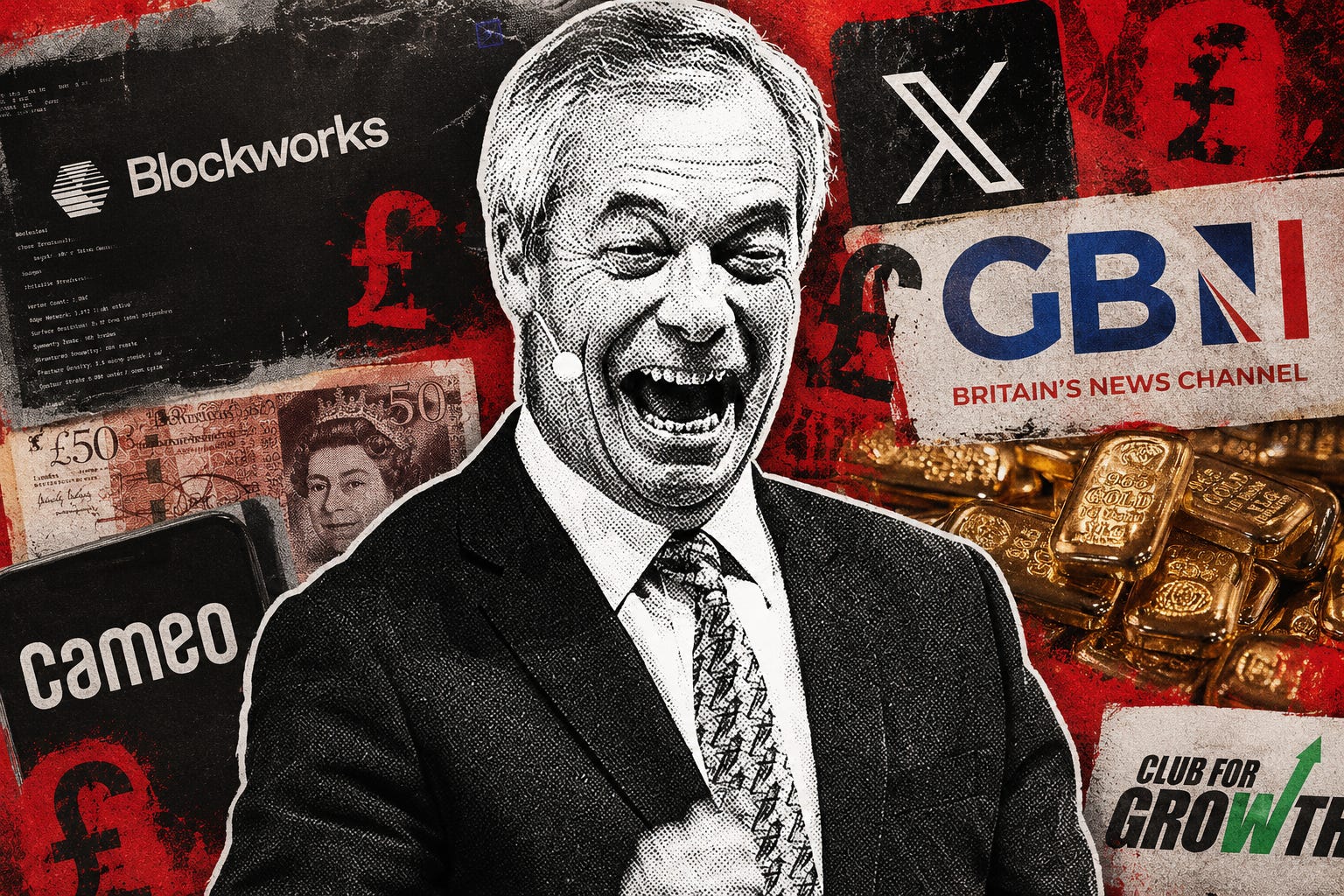
It emerged this week that Nigel Farage was paid £270,000 for just 12 hours of work promoting a gold bullion company. The man who once said “there’s no money in politics” is now pocketing a ludicrous £22,500 an hour – and that’s from just one of his sixteen side hustles.
There’s basically nothing the man won’t agree to for a fee. Since being elected to Parliament, he’s logged more than 231 hours (nearly 28 working days) reading scripts written by random people for cash on Cameo. Users have paid him to say “up the RA” – a slogan in support of the IRA – and also got him to praise a notorious paedophile.
He’s taken loads of cash from GB News and payouts from X.com, alongside speaking fees from cryptocurrency companies, PR groups, and Trump-aligned American think-tanks like the Club for Growth.
On a simple individual level, it doesn’t reflect well on him or his party. Farage has effectively ghosted his constituents in Clacton – they accuse him of “doing nothing” other than “looking for photo opportunities”. He’s also spoken far less than any other party leader in Parliament, failing to meet the basic job expectations for someone in his position.
And the jobs in question do matter. Taking money from X and GB News – two platforms owned by highly ideological billionaires – raises legitimate questions about whose interests he really serves. The same goes for crypto and gold hawking, two industries with innate political ties and a dodgy track record for fraud and scams.
So yes, he is Britain’s best-remunerated MP. But it isn’t just him. MPs have made £11 million in total in outside earnings since the 2024 election – and the top 10 MPs account for over £7 million of that haul, nearly two-thirds. By party share of all outside earnings, the Conservatives come out top at 66%, Reform (with just eight MPs) account for 20%, and Labour (with over 400) just 7%.
Farage is special here not because he is uniquely avaricious – though the argument could certainly be made – but because he functions as a kind of stress test for British democracy. In many ways, he’s an accidental auditor of our political ethics. He exposes every place where our ‘constitution’ still depends on Victorian assumptions of honour (that old ‘Good Chaps will do the right thing’ theory), rather than basic modern standards of accountability.
A constitutional system isn’t judged by how it accommodates the conscientious politician; it’s judged by how it constrains the opportunistic one. If our rules permit MPs to spend weeks earning vast sums from television contracts, corporate speeches and personalised video messages while still fulfilling the bare legal requirements of office, perhaps the problem is less the individual exploiting the loophole and more the system itself.
We were promised some tepid action on second jobs in Labour’s 2024 manifesto, and so far it’s come to nothing. On Wednesday, in a Commons debate secured by Richard Burgon MP, parliamentarians made compelling arguments in favour of a ban – the same ban we’ve been discussing since 2021, in the wake of the Owen Paterson affair, which erupted after the former MP was found to have repeatedly lobbied ministers on behalf of companies paying him as a consultant.
At least since Paterson, this has been a major factor contributing to the sense that politicians don’t play fair – that they’re in this game for their own benefit rather than public service.
The Reform UK leader didn’t even bother to show up to the debate, and got blasted by MPs from every angle. He deserved the scolding he got. But Labour’s lack of action so far has also done tremendous damage, fuelling the perception that all politicians are the same, and that democracy itself has been corroded and hollowed out.
It's perhaps no surprise then that YouGov figures show that just 4% of the public believe politicians act in the national interest, while a More in Common survey shows 87% have “not very much or no trust” in politicians.
Farage – the leader who presents himself as a man of the people while owning five mortgage-free homes and cashing in handily from billionaires at every turn – shouldn’t be listened to very seriously. But he can still teach us things. In fixing our political system, we should start to apply the Farage test: Could an opportunist easily abuse this system?
Until we answer that question honestly, we'll keep getting the same result. A ban on outside earnings isn't radical – it's the bare minimum for a profession that claims to be public service. The only thing more embarrassing than Farage's grift is Westminster's refusal to close the door behind him.
There is a clear distinction between 'earning' and 'being paid'. Most of us actually EARN our living by REAL graft while things like farrago the fascist earn NOTHING. They are grifters just like trumpty and his minions. The sooner they are ALL booted out of politics, the better !
What hold has Farage got over the government? Surely he should and could have been held to account for not fulfilling his role as a constituency MP. By all reports he is rarely seen in Clacton. The extent of his 'earnings' demonstrates the time consumed by those activities (oh, sorry, he's one of those people who wake up richer than they were when they went to sleep - Polanski's excellent definition of obscene (my descriptor) wealth).
I can't believe that we have to rely on Rupert Lowe's desire for vengeance against Nigel to bring him down.