

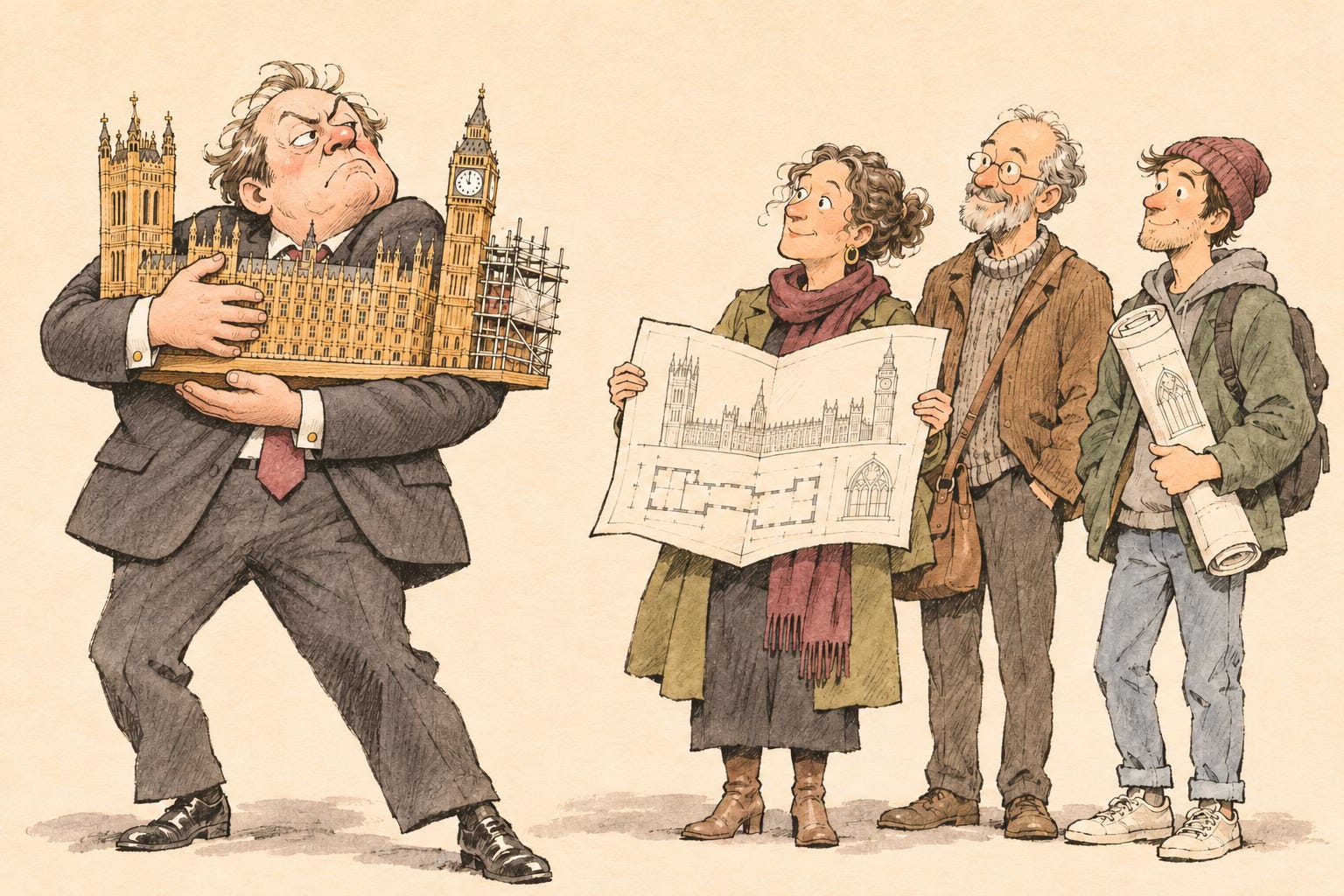
Parliament’s restoration is back in the news. Again.
The latest Public Accounts Committee report sets out the costs, the timescales and a familiar sticking point - MPs still haven’t settled whether they will move out while the work is done.
If MPs and peers leave the Palace for the main works, the whole programme is estimated at £11.1bn to £15.6bn over 19 to 24 years. The alternative being developed, which keeps the Commons in the Palace with a temporary switch to the Lords chamber, comes in at £19.5bn to £39.2bn over 38 to 61 years.
A restoration programme that could take more than half a century. After well over a decade already spent discussing it.
With plans for the National Commission on Electoral Reform taking shape, there is a lesson here worth paying attention to. The restoration saga shows how easily decisions about Parliament’s future can become shaped around the preferences of its current occupants.
Planning for the restoration began in 2012. Parliament voted to move out in 2018, passed legislation in 2019 and agreed a new approach in 2022. After all that, the preference of some parliamentarians to stay continues to shape the options being developed.
Anyone who has tried to work through building repairs will understand that fitting the job around the occupants complicates things. At Westminster, the consequences are measured in billions of pounds and decades.
Of course MPs need somewhere secure to debate, question ministers and represent their constituents. The staff need safe workplaces too. Those are practical requirements that have to be met wherever Parliament sits.
The opportunity to spend part of your career in the historic chamber is a different consideration.
In 2022, former Commons leader Chris Grayling argued that no generation of MPs should miss the chance to “spend at least a part of their time here participating in debate in this Chamber”. He supported moving out and wanted the repairs to get going - but argued for a limit on the absence.
I understand the attachment. Many MPs will have spent years hoping to serve there. But their opportunity to experience the place should carry rather less weight than protecting it for the public and everyone who comes after them.
The delay makes that point for us. Since the 2018 decision, there have been two general elections. The 2024 election alone brought in 335 first-time MPs. Many of those involved in the original decision have already left office.
Where they would carry out their daily duties is no longer a concern for them. The bill, the risks and the future of the institution remain everyone else’s concern.
MPs hold their offices for a time. They are responsible for an institution whose future extends far beyond their own careers.
That responsibility is about to be tested again. The Government is drawing up plans for the National Commission on Electoral Reform. A monumental opportunity to examine our voting system. Decisions about who will lead it, how it will work and how the public will take part are being made now.
PoliticsHome reports that those preparations are taking place amid divisions among Labour MPs and Cabinet ministers - it describes MPs worried about losing out under proportional representation.
There will be plenty of strongly held views before the commission has even started. We can already see the political pressures the commission and its recommendations will face.
While the commission is still being shaped, we have a chance to help build a truly independent process with the public at its centre that is built to succeed.
MPs bring valuable experience of representing constituents and holding government to account. Their perspective should inform the commission’s work alongside the public’s experience of trying to be heard. But the commission must be free to make recommendations without pressure to accommodate party politics, guided by the evidence and the public’s considered views.
The commission also needs a firm reporting deadline with a clear process and timetable for bringing any recommended changes before Parliament as legislation.
Get those foundations right, and the commission could give people a reason to feel their involvement matters. Its findings would have the strength of a process people could follow and trust, helping them withstand the political pressure that will come.
The restoration debate shows why getting those foundations right matters. Decisions about the building’s future have become entangled with its occupants’ preferences and attachment to the status quo. Years pass. The occupants change. The unresolved problem gets handed on.
MPs are entrusted with Parliament by and on the public’s behalf. That responsibility includes accepting that its future may look different from the version they would choose for themselves.

Good God - How on earth can it cost £11B, never mind £39B??
Surely it would be better to build a new modern purpose built parliament for a fraction of that cost.
They could then do something useful with the money saved, you know, like maybe unfreezing the income tax personal allowances.
Yes, we own Parliament and we should the MPs to vote to move it to a site more suited to the 21st century, i.e. out of London to a place which reflects that it is our National Parliament. A modern building in a central part of the country with good transport links. And once it has moved it will give our representatives a chance to escape from the corrosive influence of the lobbying groups and the financial institutions in the City of London.