

What a week it’s been for those of us interested in the resilience of UK democracy.
On Wednesday evening, the Commons gave the Representation of the People Bill its third reading by 411 votes to 102. Angela Rayner told the House it “delivers much of the Rycroft review on foreign interference”. Five of Reform UK’s eight MPs voted against (the other three did not vote), with Danny Kruger describing the whole thing as “a flagrantly partisan attempt to kneecap Reform UK”.
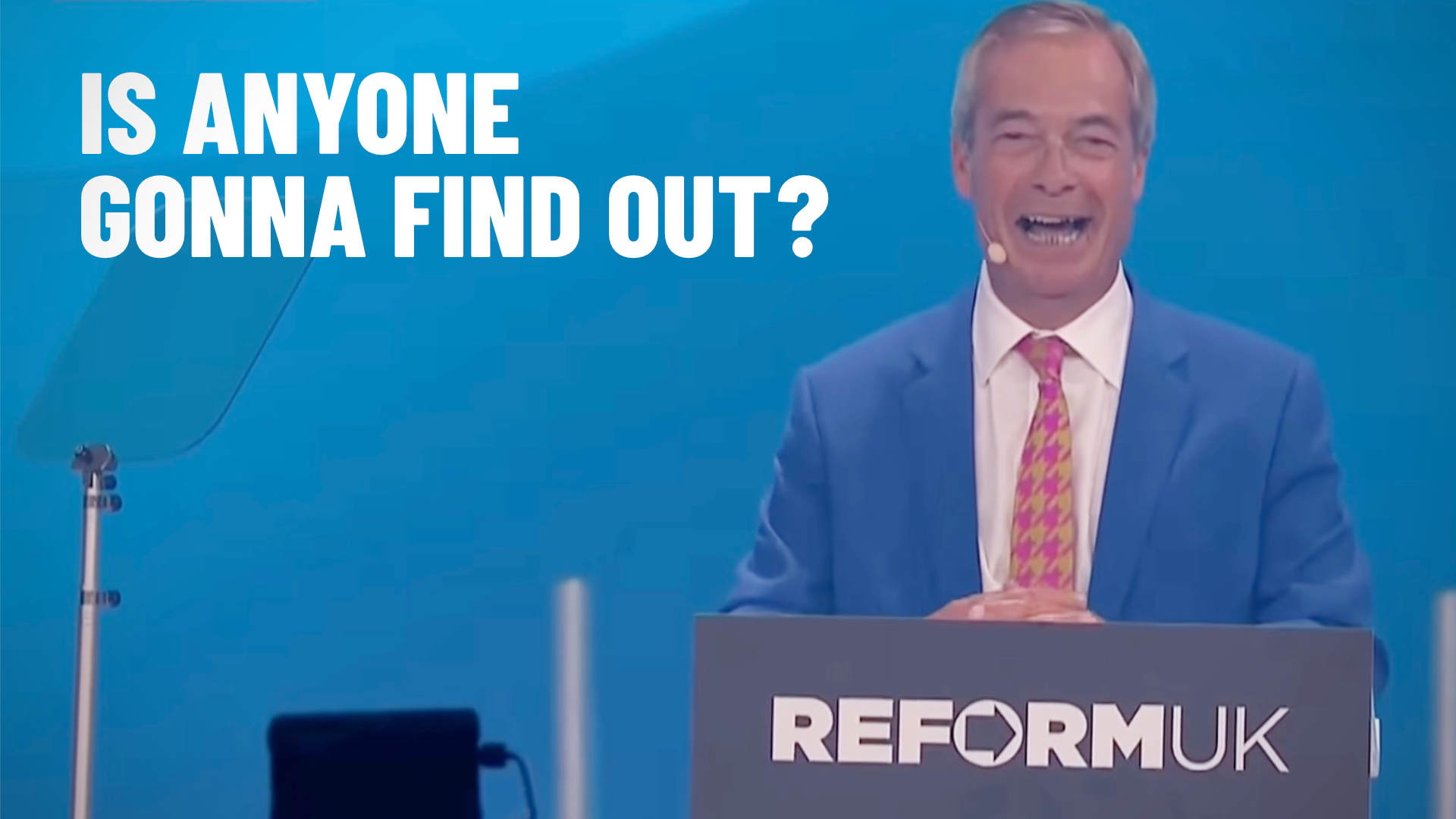
On Thursday evening, Channel 4 News broadcast a year of undercover footage from inside Reform UK. In it, the party’s head of policy, James Orr, is recorded describing the Electoral Commission as “so dumb and ineffective”, before asking the question that ought to be engraved above the door of every campaign finance regulator in the country: “Is anybody gonna find out?”
By Friday morning, both Orr and Farage’s long-serving aide and de facto chief of staff, Dan Jukes, had stepped down pending the outcome of an internal investigation. Three parties had reported Reform to the Met. Farage told LBC it was “a clear case of entrapment”, then opened his party conference insisting that “Reform has broken no law” and that the aides’ recorded remarks were “loose pub talk”.
I’ll come back to Reform. But I want to start with the bill, because it deserves a fair hearing before I tell you what’s missing from it.
Credit where it’s due
This is a better bill than the one Steve Reed introduced in February. I said at the time that it was a rare shot at reform with some obvious gaps, and I listed the things Open Britain wanted added. One of them, the repeal of the Elections Act power letting ministers hand the Electoral Commission a “strategy and policy statement”, was delivered by government amendment at committee stage. That is much more important than it sounds. It was the kind of lever a future government with a grudge against the regulator could have pulled without a debate and our democracy is safer without it.
On Wednesday, the Government added a further tranche of measures lifted straight from the Rycroft review. Crypto donations are banned outright, retrospectively to 25 March, and any received since must be returned. Overseas electors can now give no more than £100,000 a year, and someone who moves back to the UK to dodge that cap stays inside it for the rest of the year and the whole of the next. Company donations must now be backed by real post-tax profits, assessed over five years, rather than by turnover.
That last change also matters more than it sounds. In June, Byline Times found seven companies that had given Reform around £485,000 between them while facing strike-off, liquidation or dissolution. The Electoral Commission confirmed in July that a company can be “in liquidation, dormant or late in filing documents” and still be a permissible donor. Under the profit test, a company with no qualifying profits cannot donate. As far as I can tell, most of those seven would have been caught.
Add to that a statutory information gateway between the Commission and other public bodies, a power for the Commission to demand documents from anyone without first opening a formal investigation, votes at 16, and the first real move towards automatic registration, and you have a piece of legislation that Open Britain can genuinely support without holding its nose.
So: well done. I mean that.
What the tape actually shows
Now the difficult part - starting with a paragraph to soothe the nerves of OB’s lawyers.
The Channel 4 investigation, by the not-for-profit group Verbatim, did not catch Reform banking foreign money directly. No £500,000 changed hands. Reform denies wrongdoing; Farage says he has a KC’s opinion and that the polling at the centre of the story was commissioned by “an independent third party”. The police are assessing. Nothing has been proven, and this piece does not claim otherwise.
What the tape shows is a mindset. It shows senior people in Reform UK discussing £32,500 of polling, commissioned by Reform aides and paid for by an American company, in terms that leave little room for doubt about the appeal. Jukes calls such arrangements “an amazing sweet spot” because “they don’t show up anywhere in public records”. It shows him explaining (in relation to a proposed £500,000 from the undercover reporter’s fictional American father) that “it’s the father and it’s the son. So that’s one of the ways in which we do it.”
Then there is the Electoral Commission’s response, which is worth reading twice. Reform’s official statement said its donor vetting process was “approved by the Electoral Commission”. The Commission replied that it “has not approved the donor vetting process for Reform, or any other party”. It added, with a regulator’s economy of words, that “any potential attempt to evade the controls on donations is for the police to consider”.
Note what the Commission is saying there. This is a matter for the police because the law already covers it. Donating on someone else's behalf is banned. Undeclared donations in kind are banned; Gavin Millar KC's view, given to the investigators, is that paying for a party's polling "is a donation just as much as giving a gift of money directly". Wednesday's bill has nothing to add to that. What it cannot do, on its own, is answer Orr's question. Rules about where money comes from are only as good as the odds of someone checking, and the new Commission powers do improve those odds. But they leave untouched the thing that made these Reform officials ask the question in the first place. A donor with a UK postcode can still hand over any sum at all, which means the "father and son" route has no ceiling either, and the prize for not being found out clearly justifies the risk in Reform’s eyes.
The omission that everyone in the Chamber could see
That is the first of three omissions, and it is the big one. There is still no cap on what a UK-based individual can give.
Stella Creasy laid it out with numbers. In the first quarter of this year Reform took £9.9 million in donations, more, she said, than the Government and opposition parties “put together”. Around £8 million of that came from three people, “all of whom have a UK postcode”. As she put it: “Nothing in the Bill as it stands will affect that.” Christopher Harborne’s £9 million, revealed last December, was the largest donation any living person has ever made to a British party. Under this bill, he could do it again next week.
The politics of how the domestic cap died are instructive, because they tell you what the Burnham government is made of.
In May, still mayor of Manchester, Andy Burnham wrote “yes, I do think there should be a cap on political donations”, suggesting a starting figure of around £500,000, to be reduced over time. Creasy tabled exactly that: £500,000 immediately, falling to £100,000, with trade union political funds exempt. Then, on 26 August, the Guardian reported that the Prime Minister would not back it, following a lobbying campaign by Labour’s affiliated unions. The GMB had written to 80 MPs warning that the amendment “risks having significant unintended consequences”.
On Wednesday the minister, Florence Eshalomi, announced instead that “the new cross-Government task and finish team” would be working “at pace to find a solution without unintended consequences”. Same phrase as the GMB letter. When Lisa Smart asked whether that meant something would be in place before the next election, the minister replied that she could not “unilaterally write the terms of reference for the taskforce”. Creasy did not press her amendment to a vote. The only cap-related division of the evening was on a Liberal Democrat proposal for a Royal Commission merely to study the question. Labour and Conservative MPs marched through the same lobby to defeat it, 427 to 85.
Let me be fair to the unions, because I think the argument deserves better than “unintended consequences”. Union money is different. Millions of members making small contributions through a political fund, already more heavily regulated than most political money in Britain, is close to the cleanest funding model we have. Creasy’s amendment recognised that and exempted it. The unions’ real worry is strategic: once the principle of a cap is on the statute book, a future government of a different colour could redraw the exemption. That is a legitimate fear. It is also one that can be answered in drafting, and it should be argued in public rather than settled in a letter to 80 MPs.
Because the alternative is what we have now. A Prime Minister who said he supported a cap. A Parliament in which dozens of MPs, most of them Labour, put their names to one. A public that, in every poll I have seen, supports one by a crushing margin. And a task-force with no terms of reference, no membership and no deadline.
The omission that was not even allowed in the room
The second omission never even made it to the floor. Alex Sobel’s new clause 31 would have required the Government to report within three months on the feasibility of a National Commission on Electoral Reform. More than 170 MPs from eight parties signed it, more than half of them Labour. The Chair ruled it out of scope. When members strayed towards the subject, the Deputy Speaker intervened: “Before we delve into a rabbit hole about proportional representation, it might be helpful if I remind all Members that it is out of scope of the Bill.”
A bill called the Representation of the People Bill, in which the representation of the people could not be discussed…a point made eloquently in the debate by Green MP, Dr Ellie Chowns.
The day before, in his first statement as Prime Minister, Burnham had been asked twice about the commission. To Ed Davey he offered a Cabinet Office task-force. To Lisa Smart he said that “there needs to be a mandate” for changing the voting system, and that if there is a consensus at the next election “a change can be made in the next Parliament”. At no point did he commit to the commission. He is right that a change needs a mandate. But a manifesto line saying “proportional representation” names a family of systems, not a particular system, and voters cannot give a mandate for something nobody has described. The commission is how you do the homework required to seek a meaningful mandate. It needs no legislation. It could be announced next week. We published a short guide on exactly this earlier in the week, and I will not repeat it here.
The omission nobody in government wants to talk about
The third is quieter. The Government says it has accepted all seventeen of Rycroft’s recommendations. Read the response, though, and you find one it has quietly parked. Recommendation 16 asked the Government to look at “potential channels for foreign money to flow into the wider political eco-system”: think tanks, lobbying, the influence economy that sits upstream of any donation. The Government’s answer in July was that these “are issues which warrant careful consideration” and that it would “consider opportunities for further work in the future”.
That is a door the bill leaves wide open. Two weeks ago we wrote about the US State Department planning to put $12 million into British right-wing organisations. None of that is a political donation. None of it is touched by Wednesday’s amendments. And there is still no independent inquiry into foreign interference in British politics, which Open Britain has been asking for since the spring. A regulatory review is not an investigation, however good its recommendations.
What happens now
The bill went to the Lords on Thursday. Second reading is pencilled in for 14 September. Rayner told the Commons she looked forward to “a strengthened Bill returning”, and Creasy noted, pointedly, that “the Lords already hear about what is happening”. That is where the cap fight moves next, and peers are less easily whipped than a Labour backbench in its second month under a new leader.
Three things would turn a decent bill into a good one, and none of them needs to wait for a manifesto.
Give the task and finish team terms of reference, a membership and a date, and make that date fall before the next general election. Announce the National Commission on Electoral Reform, which requires no law and would have most of the Commons behind it. And commission the inquiry into foreign interference that Rycroft was never designed to be.
This week, the Commons partially closed the front door. Then a television crew showed us people inside the house, on tape, talking about how the back door is still wide open.
So, “Is anybody gonna find out?” The honest answer, this week, was: only because someone happened to be filming. The job of the next few months is to make sure the defence of our democracy is not left to a film crew.

I should, perhaps, have included a link to the National Commission report referred to in this piece. Those interested in that can find it at the link below. 👍🏻
https://www.biggerthanpolitics.com/the-national-commission-on-electoral-reform-in-a-nutshell
Thank you for this clear and important summary.