

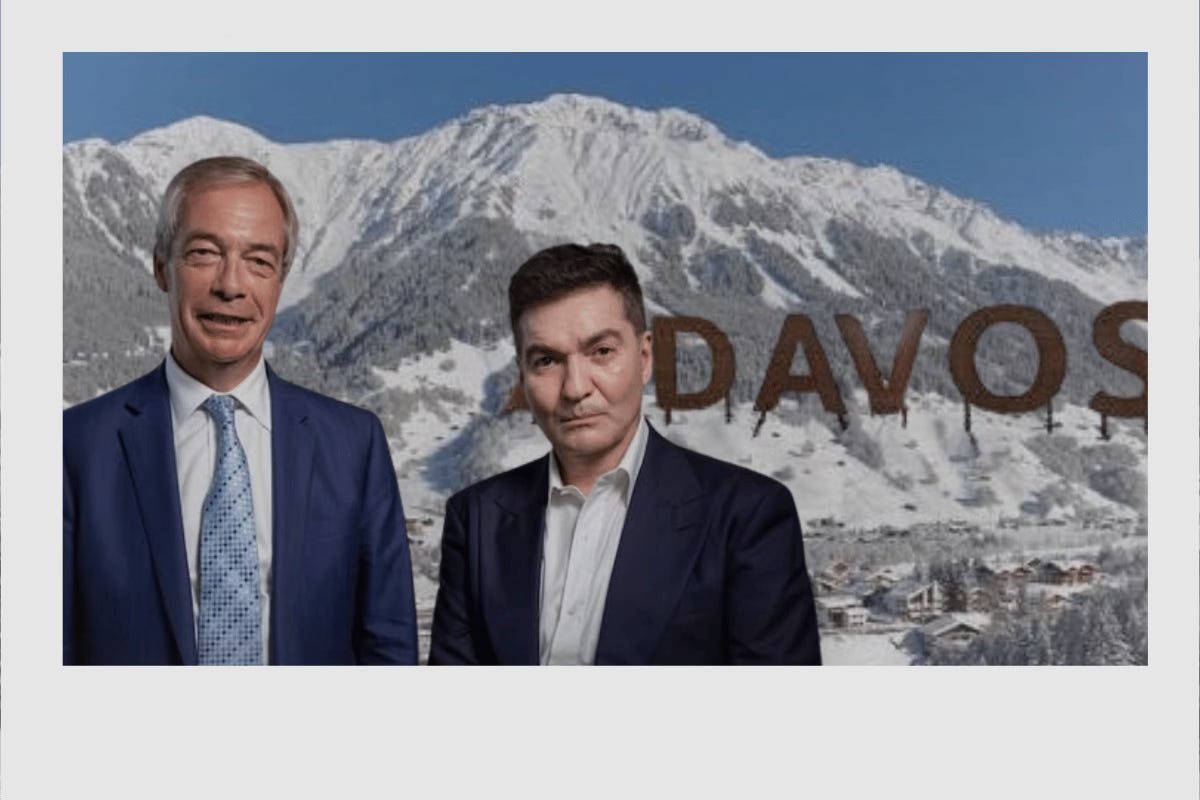
The party of ‘ordinary people’ has an extraordinary appetite for billionaires.
Billionaire Sasan Ghandehari says he is moving his tax residency from Switzerland to the UK to make “regular payments” of more than “one or two million” to Reform.
Changing your tax residency to bankroll a political party is quite a commitment. I’d like to know what he’s hoping to get out of this. What does he expect a Reform government to do that makes moving his tax residency and handing over millions worth it?
Farage has offered a clue about the attention Ghandehari already commands: “when we spend time together, I listen very carefully”.
Meanwhile most voters are wondering if their MPs in Westminster even read their emails.
If a handful of people are paying to keep your party going, you’re going to care rather a lot about keeping them happy. A donation should never buy a better chance of being heard.
Then there’s what we’re learning about the man Farage is listening to.
This week, the Guardian reported on Ghandehari’s past business dealings with an Iranian religious foundation linked to the country’s leadership. French court proceedings describe a telecommunications venture in which a company owned by his family’s HP Trust held a 49% stake. The other 51% belonged to Astan Quds Razavi, or AQR.
AQR sits under the authority of Iran’s supreme leader. The US sanctioned it in 2021, describing extensive economic holdings that benefited Iran’s leadership, including assets confiscated from dissidents and religious minorities.
The venture had broken down in 2016, before that designation. His lawyers say Western authorities approved the project, which aimed to encourage reform, and that he subsequently suffered asset seizures.
I’d still like Reform to explain what it has established about Ghandehari’s business interests, past dealings and sources of wealth. When someone offers to help fund your route into government, those seem like fairly basic questions.
The relationship with Farage also appears to offer something valuable in the other direction.
In a case involving Christie’s and a Picasso painting, questions arose about whether a company linked to Ghandehari could meet roughly £1.5m in legal costs. The company’s lawyers said Ghandehari could cover its liabilities. Among the material they relied on was a World Economic Forum brochure describing his family trust as having investments worth more than $10bn.
A useful souvenir from a Davos trip he had paid for Farage to attend.
Ultimately the judge wasn’t satisfied that adequate evidence of his finances had been supplied but what interests me here is the wider value of these relationships.
Farage was listed on the World Economic Forum programme as both an MP and a representative of HP Trust - the family office of Ghandehari’s family trust.
You can see what the association might offer Ghandehari. Farage brings the status of a sitting MP and party leader into the relationship. That public credibility has value well beyond the price of a Davos pass and voters are entitled to scrutinise who benefits from being associated with it.
Even if every question about Ghandehari’s finances were answered tomorrow, I’d still want a limit on how much he could give.
His money could be entirely legitimate, every eligibility check could be passed, and a party could still become far too dependent on keeping him happy. A clean bill of financial health would do nothing to change that.
No party should be in that position. The principle should apply whether the cheque is made out to Reform, Labour, the Conservatives or anyone else.
Yet there is currently no universal cap on political donations. An eligible donor can give millions, then millions more.
Stronger checks help establish where the money comes from. A universal cap would limit how much any donor can give. We need both.
The Government has proposed stronger checks, restrictions on company donations, a crypto donation ban and an annual cap on donations from overseas electors. I welcome those measures.
The Representation of the People Bill gives Parliament an opportunity to tackle unlimited donations more broadly too. Instead of committing to use it for that purpose, it has established a task and finish team.
On Tuesday, we got an insight into how far the Government’s response has progressed. Democracy minister Florence Eshalomi appeared before a parliamentary committee examining its electoral reforms, where MPs questioned her about the task and finish team.
Asked directly whether it would consider a universal donation cap, she said ministers were “still in the process of writing the formal terms of reference”. She gave no firm commitment to include one.
Asked when those terms would be complete and the team could start, she described the work as a priority for herself and the Prime Minister. I’d have found that more reassuring if it had come with a date. It didn’t.
Ben Delo and Christopher Harborne announced £72m of donations between them in September. Ghandehari had already pledged millions over the summer. That’s another billionaire prepared to become a substantial source of funding for Reform, while ministers are still writing the brief for the team examining the problem.
Money on this scale can pay for staff, communications and organisation long before an election is called. Parties build their advantage between elections. Delaying reform gives unlimited donations more time to shape the political landscape.
Of course a cap needs proper rules. Loans, companies and connected donors all need to be covered, so someone can’t get round it. But the scale and speed of the Government’s response need to match what is happening now. Ministers should publish the team’s remit and explicitly include a meaningful universal donations cap in time to protect the integrity of our next election.
Billionaires aren’t waiting for the working group.

Poor old Nigel, he's been in Politics and Public life for Eleventy Three Years, yet is still having to grub around for more cash.
He's not very good, is he?