

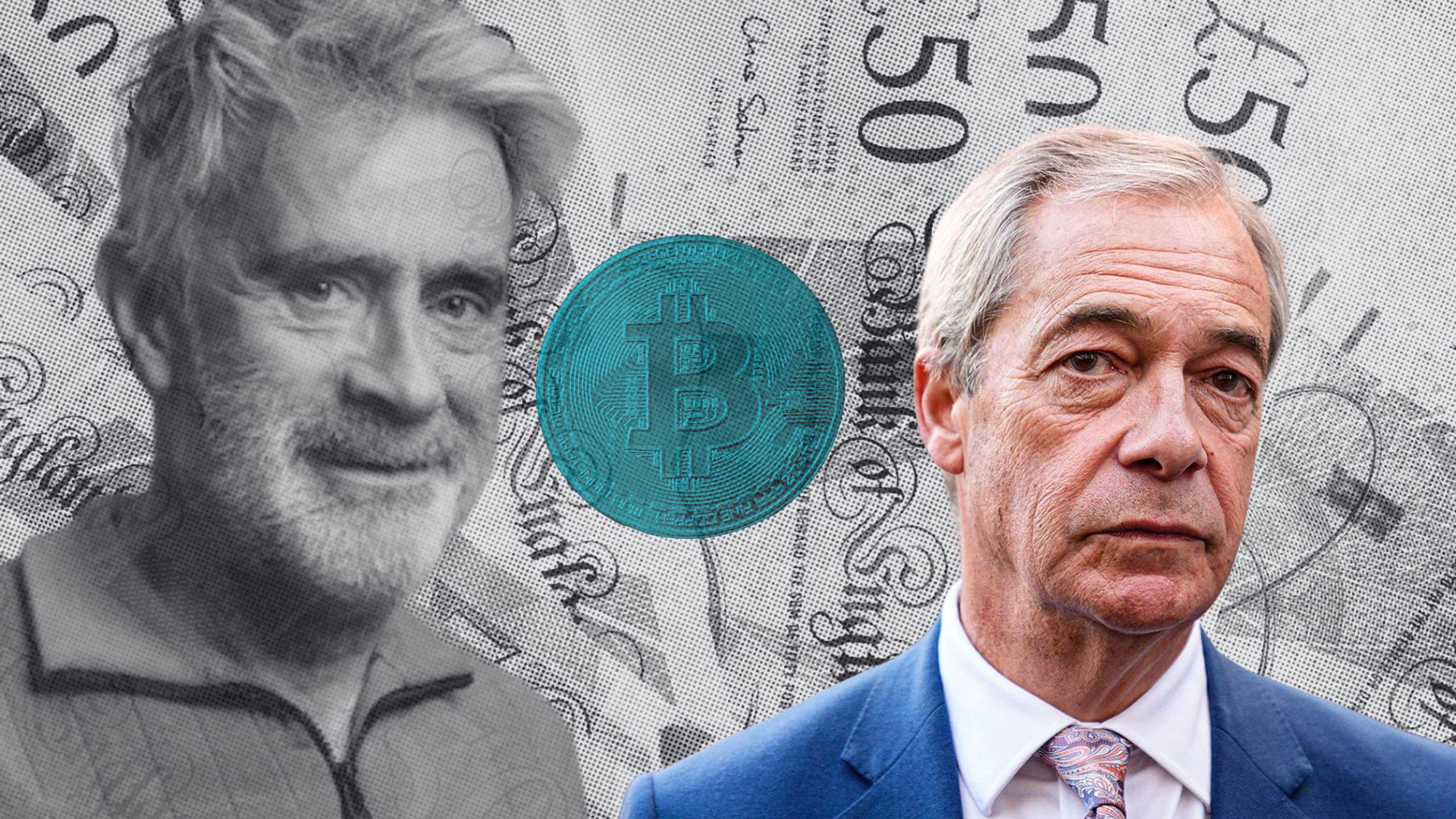
Westminster is ripe with scandals these days, but The Guardian just uncovered a whopper.
Cryptocurrency billionaire Christopher Harborne reportedly gave Farage an undisclosed £5 million personal gift just before he announced he’d run for his seat in Clacton in 2024. That tax-free gift is the largest known sum ever accepted by an individual politician in British history. Farage has been referred to the standards committee in light of the revelations.
Harborne’s cumulative donations to Farage and his various parties over the years (including the Brexit party) now total more than £27 million. That’s a staggering sum.
I’ve been writing for years about how big money corrodes politics. We’ve all seen the damage it can do in the United States’ backwards ‘money-is-speech’ political system. Large-sum donations continue to climb here in Britain too, while politicians are captured by vested interests and trust falls to record lows.
But I have to say this latest fiasco is genuinely absurd. One can infer from the revelations that billionaires like Harborne can now effectively buy their own MPs. That one deep-pocketed individual with a pet project can single handedly shift the political landscape of a nation. And in this most recent case, were it not for the work of wily journalists, we probably wouldn’t even know about it.
Money Behind the Mask:
Harborne clearly has a type. The Thailand-based billionaire (also known as Chakrit Sakunkrit) previously gave generously to the Brexit party. He also endowed the personal office of Boris Johnson with £1 million in 2022, just months before a company in which he was majority shareholder (QinetiQ) received an £80 million defence contract. A pretty good return on investment.
So with Reform UK on the rise, it’s not a huge shock that he’s betting big. He seems to have helped Farage finally make his way into Parliament (on his eighth attempt) in 2024, and his money will now surely boost Reform in upcoming local elections.
Farage has claimed that the £5 million was for his security services, that “Christopher is an ardent supporter who is deeply concerned for my safety.” This morning – hours before the Guardian report came out – he conveniently dropped a story to The Telegraph about an arson attack on his home more than a year ago. I’ll leave it to you to judge whether it’s normal to spend £5 million on a simple security detail.
But Farage and his party have seemingly had a lot of expendable income. Reform UK petrol stations sell fuel at slashed prices, and prize draws offer to pay energy bills for entire streets. They’re massively outspending their opponents ahead of local elections. Farage himself scrounged up £215k to invest in Kwasi Kwarteng’s bitcoin company.
“Hand on heart, I haven’t promised [Harborne] a thing,” Farage says.
Forgive me if I can’t bring myself to believe it. Even if there’s no explicit promise – I’d expect that at the least there’s an understanding of mutual interest. And it’s pretty clear where that interest lies.
Crypto-Politics:
In the Epstein files, email exchanges between former Trump strategist Steve Bannon and the disgraced sex trafficker reveal that they viewed cryptocurrencies as a tool to destabilise the global order and break free from the pesky rules and regulations of the traditional financial system. More than that, they sought to use it to discreetly fund a “populist/nationalist coalition.”
Bannon saw Farage as a key player in his so-called “European revolution,” his effort to bolster far-right movements in the late 2010s including Viktor Orbán, Germany’s AfD, and the Brexiteers. He told Epstein he could pressure these parties to “shut down” any legislation regulating cryptocurrencies.
While there is no evidence Harborne has any connection to this network, it seems possible he is thinking in the same terms. He is in a perfect position to benefit from a crypto revolution. He’s heavily leveraged in the industry, an early buyer of digital tokens that have skyrocketed in value.
As with Trump and his crypto industry pals across the Atlantic, Farage seems keen to help him. Not only is Reform UK the first party to accept crypto donations, but he also advocates for a state-owned bitcoin reserve, deregulating the industry, and slashing taxes on the sector. “I am your champion,” he told a crypto conference in London last year.
It presents a contradiction for Reform UK voters, one that will only get harder to ignore. A movement that claims to be a grassroots rebellion challenging establishment power is intertwined with a financial system designed to evade oversight altogether – one that disproportionately benefits the extremely wealthy insiders funding it.
Elite Populism:
Russell Jackson at Byline Times recently deployed a term for Reform UK that resonated with me. He calls them “Elite Populists.”
The ranks of Reform UK are largely former attendees of elite all-boys schools. Many made a lot of money in the high-powered corporate world. They manufacture anger and grievance on racial and cultural lines, all while remaining deeply embedded in the very establishment they claim to be fighting.
“What masquerades as rebellion from below is oligarchy from above – a repackaging of class power as cultural revolt. The theatre of ‘authentic’ anger conceals the reality that these movements are fuelled, financed, and amplified by the ultra-rich, who are the primary beneficiaries,” Jackson writes.
It’s why Harborne is a vulnerability for Farage’s entire project. If people in Clacton and beyond are allowed to figure out what this party really is – a ruthless business operation by and for the wealthy in the vestige of a grassroots political party – it is likely to lose its lustre for many.
It’s easy to fixate on figures like Harborne (and they deserve scrutiny) but they are symptoms, not causes. Our political system has left the door open to the powerful few. It’s a structural failure that many could have predicted – and many did.
That door can be closed again with meaningful regulation. Parliamentarians, in their neglect, got us into this mess. We’ll need bold legislation - starting with the Representation of the People Bill - to close that door.

I expect the vile Farage will be told not to accept overlarge donations in the future which he will ignore. Ideally he should be sacked as MP, and Clacton put up for a by-election so they can elect someone who actually cares for them.
It's just a stroke or two of the pen to modify 'explicit' to 'exploit' it occurs to me whilst reading your piece, Matt.
Could they be connected?