

It takes a certain confidence to accept £5 million from a billionaire and then complain that the establishment is picking on you. Nigel Farage appears to have it.
His finances are part of a wider story. From Westminster to the Senedd, Reform is presenting scrutiny of its politicians as an attack on the people who voted for them. A question about conduct becomes another confrontation between the public and the establishment.
Appearing on the BBC he was asked whether he expected Parliament’s standards commissioner to find against him over the gift from Christopher Harborne.
“Do I think the establishment would find against me, the leader of an insurgent party? What a question to ask.”
Farage is a sitting MP with a £5 million gift to explain. Somehow, he gets to be the little man in this encounter.
The money arrived before Farage became an MP in 2024. He says it was a personal gift for security and did not need declaring. The commissioner is investigating whether it should have been registered, and there is still no published finding.
There is, however, already a story ready for one.
Farage is rolling the pitch, giving supporters an explanation that can survive an adverse finding. Before supporters have seen the commissioner’s reasoning, a finding against him can already be filed under Nigel versus the establishment.
He has already invited voters to make his fight with the establishment their own.
In July, with questions mounting about his finances, Farage announced that he would resign and contest a by-election. The “people of Clacton” should be “the judges of my actions”, he said. He billed the contest as a battle between the people and the establishment.
Reform’s own website was helpfully explicit about what this was supposed to achieve. It quoted Robert Jenrick saying Farage wanted to “settle this matter once and for all in the hands of the people”.
Farage won. The standards investigation resumed.
But cast the election as the people’s verdict on his conduct, and the investigation takes on a different meaning. Continuing to ask questions can be presented as refusing to accept the voters’ answer.
His supporters supply the authority - the people investigating him become the ones supposedly defying democracy.
The same dangerous logic is at work in Wales.
Last week Joe Martin, a Reform member of the Senedd, asked about the “demographic replacement of white British people”. The presiding officer ruled his contribution discriminatory and offensive. Martin had been warned about his conduct before.
His participation in debates has been restricted until he apologises. He can still ask ministers questions. His colleagues remain free to speak.
Farage weighed in emphasising that Martin was “duly elected”, and asking “Why is it only Reform that’s targeted like this?”
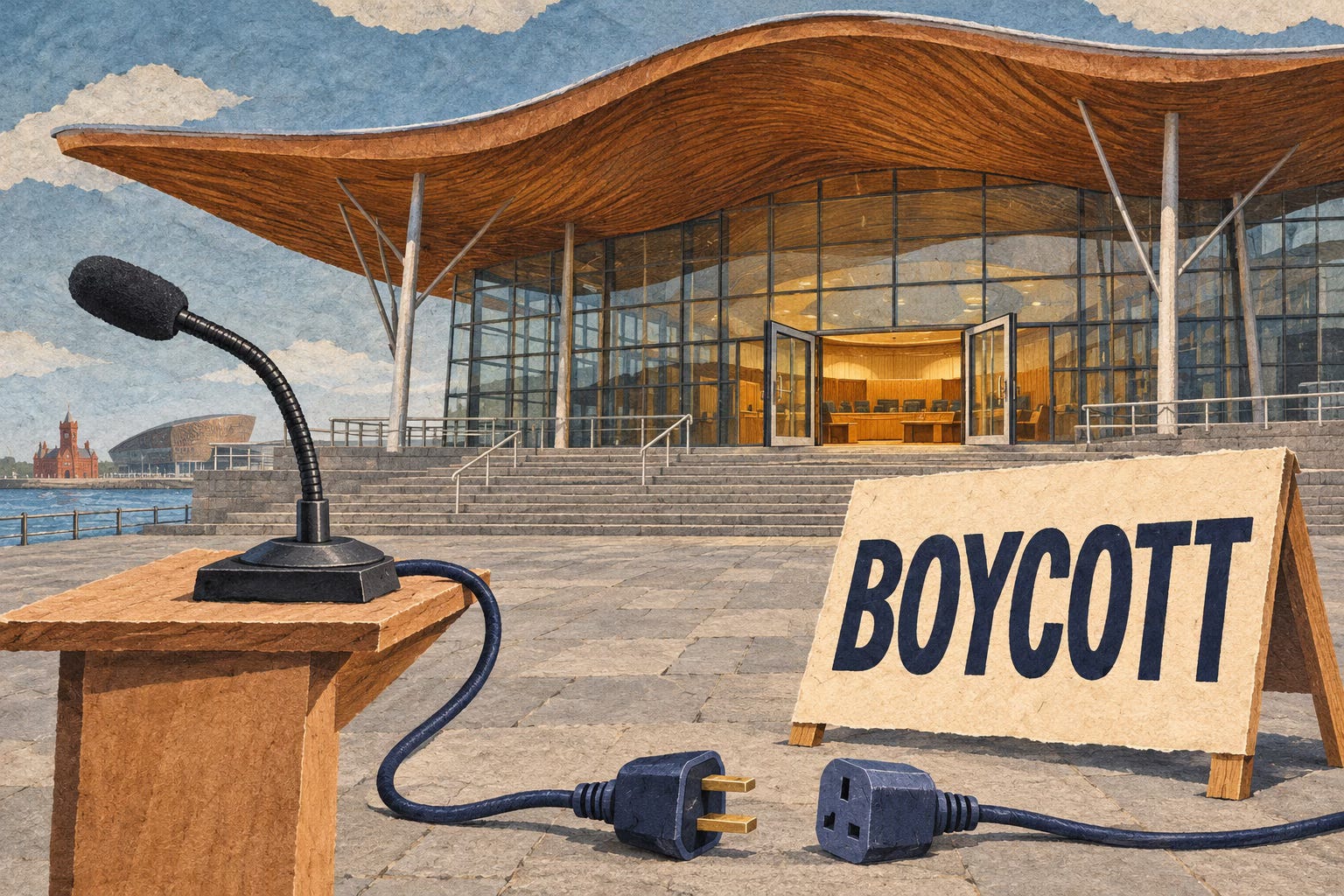
Reform announced a boycott of plenary proceedings. Its Welsh leader, Helen Jenner, declared: “We will not let our voters be silenced.”
The voters had not been sanctioned. A politician had been required to meet standards of parliamentary conduct. Yet Reform was telling its supporters that they were the ones being silenced.
The party would defend their voice. First, though, it would stop using it.
On the day the boycott began, Reform’s Gareth Beer was due to ask the Welsh Government what it was doing to prevent the closure of GP practices in his constituency. When his turn came, he was absent. The question went unasked.
Reform had invoked its voters’ right to be heard to defend a colleague, then declined an opportunity to speak for them.
An answer about GP services could have been useful to the public. Another round of publicity about Reform’s mistreatment was useful to the party.
By Tuesday, the boycott had extended to First Minister’s Questions and the debate on the Welsh Government’s draft budget. Jenner was absent when called to question the First Minister. On Wednesday, Reform withdrew its own proposed debate on freedom of speech. Even an opportunity to argue about being silenced went unused.
Its members did take part in Wednesday’s votes. But questions and debates are part of representation too. Ministers had decisions to explain, and Reform had opportunities to challenge them.
Instead, its voters were being asked to accept less representation as proof that the party was standing up for them.
The same claim runs through both episodes - we speak for you, so an attack on us is an attack on you. The establishment is trying to stop us because it wants to stop you.
Reform has plenty to draw on when it talks about an establishment that protects its own. People have watched rules bent, misconduct excused and powerful people escape consequences. They have good reason to want something better.
But look where that public anger is being directed. A commissioner investigating a politician’s finances becomes an establishment enemy. A presiding officer enforcing parliamentary standards becomes someone silencing the public. The safeguards that should answer voters’ demands for accountability are presented as further evidence that the system is against them.
For those who buy it, confidence in the politician survives. It is confidence in the people holding them to account that takes the hit.
That distrust has uses beyond surviving an investigation. Once those safeguards have been recast as enemies of the public, dismissing their findings or weakening their powers can be presented as giving people back control.
This is a dangerous manipulation of public anger. The public does not gain power when politicians become harder to hold to account. The politicians do.

Native Americans used to say, "The man speaks with a forked tongue". Maybe there was a Farage around then too! He certainly fits the bill: twisting, turning and squirming the language to suit his own argument, then getting in a tantrum when people don't buy it. Pathetic.
Reform UK is utterly abhorrent and unBritish. Thanks to Farage and all the f**kwits who were persuaded by him, the UK was dragged out of Europe and plunged into fiscal ruin, a situation which prospered only a tiny percentage of the country and weakened us considerably.