

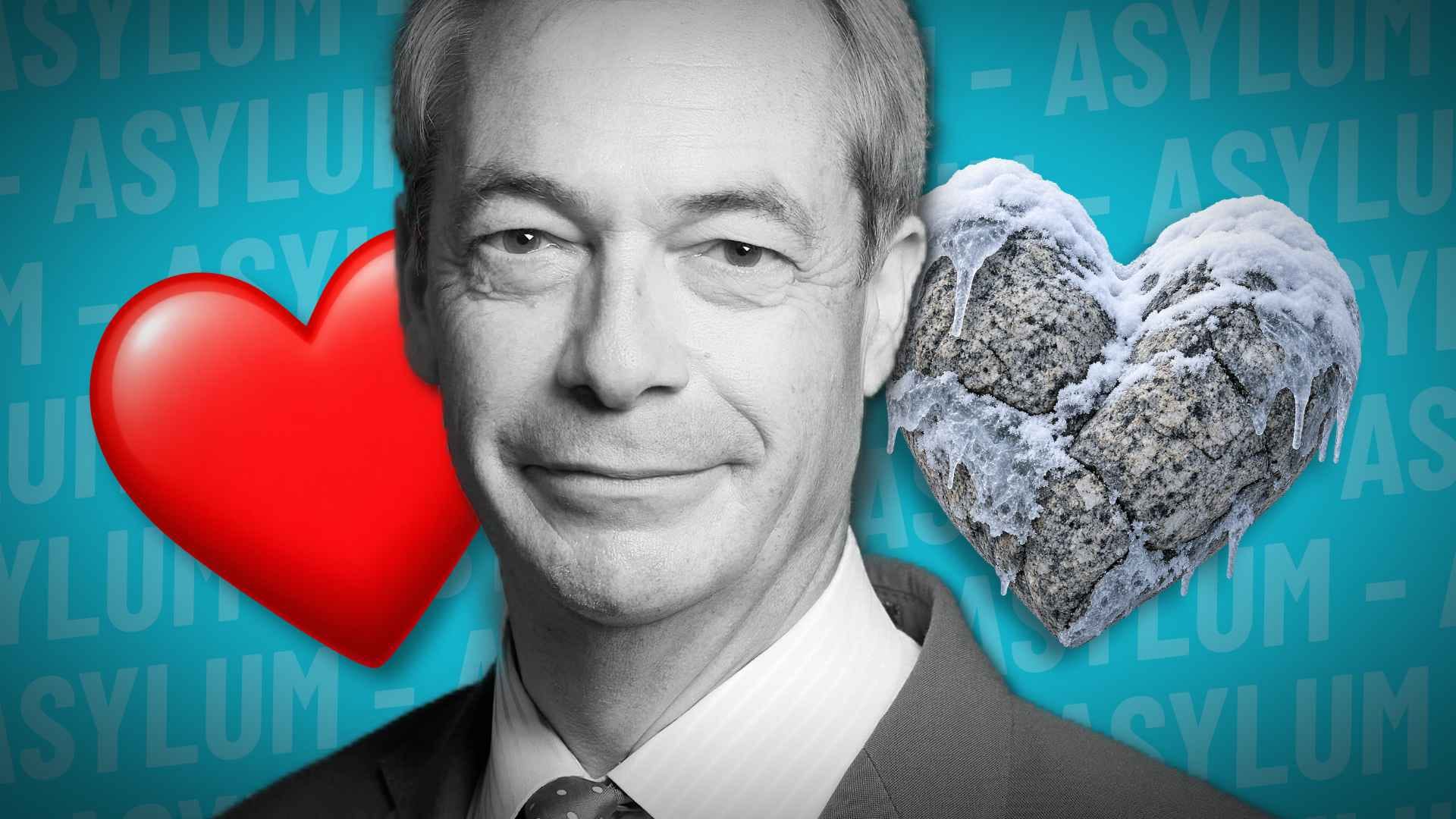
When we vote, we aren’t just picking a name on a ballot paper. We’re choosing what kind of world we want to live in, and handing the people we elect the power to build it. If they win, that power is enormous. So it’s worth asking, before we hand it over, whether the world they promise is the one they’d actually build and one we’d want to wake up in.
On Monday, in Hythe, Nigel Farage and Zia Yusuf gave us a glimpse of the future world they want to build. In front of a replica dinghy, they set out a plan to suspend the asylum system for a full parliamentary term. Every new claim rejected. Existing claims voided. The asylum tribunal scrapped, and the 90,000 people currently with appeal cases deported. Yusuf talked of deporting “north of 1 million people”. Children and mothers would not be exempt. Asked about children, Farage said that letting in Afghan or Palestinian women and children “may well sound compassionate”, but would open the door to “husbands coming, to partners coming, before you know it you have plenty of young men coming as well.”
I can say, categorically, that this is not a world I want to live in.
What strikes me most is the language. People become numbers to be counted, categorised and shifted around, like packing crates in a warehouse. A million here, 90,000 there. Women and children are a door that has to stay shut in case someone else walks through it.
I know these people aren’t packing crates, because I used to sit across a table from them.
In 1992 I joined the Home Office as an asylum caseworker, in the South and South-East Asia section of what was then the Asylum Division of the Immigration and Nationality Department. My job was to assess asylum claims under the 1951 UN Refugee Convention, which protects people with a well-founded fear of persecution because of their race, religion, nationality, political opinion or membership of a particular social group. Part of that job was conducting in-person interviews with claimants: filling the gaps in their applications, testing their accounts, challenging inconsistencies and factual errors their claims depended on.
Let me be clear about something, because it comes up in every conversation I have about our asylum system. Many of the claims I assessed - the vast majority, in fact - did not qualify. Most of those came from people, often young men, who appeared to be seeking a better economic future for themselves and their families. I never blamed them for trying. But that isn’t grounds for asylum, so I felt no guilt in recommending refusal. That’s not what the asylum system is for.
But some people did qualify. And their stories are still clear in my head more than 30 years later.
There was a Sikh activist who had a kettle of boiling water poured over him during a police interrogation. Another man who had been tortured with red-hot metal pressed against his skin. There was a woman from a minority Muslim sect. When her husband died, her neighbours harassed her by throwing stones through her windows at night. She sought the help of the local police. They publicly ridiculed her, and then several officers gang-raped her in front of her young children. There were young Tamil men forced to inhale the fumes of burnt chilli powder by Sri Lankan police.
There were others but I will leave it there - you get the picture.
I can still recall the faces of these people as they told me what had happened to them. And I remember the tears in the eyes of the interpreters, as they translated words no one should ever have to hear.
These were real human beings. They had survived things most of us can barely imagine, and then made a monumental effort to reach safety, in a country they knew as law-abiding and compassionate, where they believed they could live the rest of their lives in peace. They were not packing cases or numbers on a spreadsheet.
Under Reform’s plan, their claims would have been rejected automatically. None of them would have had an interview. There would be no one across the table, no one testing their account, no one to say yes. The point of a hearing is to sort the chancer from the torture survivor. A blanket ban doesn’t sort them; it stops anyone looking. Yusuf says Reform is “not in the business of sending people to be killed or tortured”, and that “edge cases” could be sent to third countries. But without a hearing, who can know where the edge cases are?
And the people this would catch are not who the slogans suggest. In the year to June 2026, roughly four in ten people claiming asylum in the UK were women or children, according to the Home Office’s own figures.
To do all this, Reform says it would leave the European Convention on Human Rights, repeal the Human Rights Act and disapply the Refugee Convention, so the courts can’t stop it. That is the part that should worry everyone, whatever they think about immigration. It means switching off the checks that stop any government doing whatever it likes to people it has decided don’t count. Britain helped write the post-war rules on protecting the persecuted. Walking away from them would say something about who we are. And it would leave all of us exposed too.
In his interview on The Rest Is Politics: Leading, released at the weekend, the Prime Minister, Andy Burnham, said that “Britain has to stand for something first and foremost”, and spoke of standing “for the rule of law, for international organisations and doing things properly.” Whatever your politics, that’s worth applauding. And most people in this country seem to share those values, including most people who vote Reform. When More in Common asked last November, only a third of Reform voters (36%) wanted to close our borders to people fleeing war and persecution. Nearly three in five (59%) wanted them to come through capped, controlled routes. Wanting control is not the same as wanting cruelty.
Which brings me back to the ballot paper. Under our voting system, a party doesn’t need most of us to agree with it to win power. In 2024, Labour won a large majority of seats on about a third of the vote. As recently as April, More in Common’s model had Reform within touching distance of a Commons majority on just 28% of the vote. Yes, polls move, and Reform’s numbers have fallen since. But More in Common’s latest model, from September, found that a five-point swing from Labour to Reform would be enough to give Reform a majority. That would still be well under a third of the vote. The rules that would let a minority hand itself near-unchecked power haven’t changed.
At the next election, we’ll hand power to one group of politicians or another, and they’ll build the world we all have to live in. I hope it’s a group that stands up for democracy and human rights, and has the courage to show compassion to people who need it, wherever in the world they come from. I hope it’s not one designed by a group of zealots propelled by a minority who don’t embody the best of this country’s tradition for fairness and compassion.

Farage is truly an ugly human being. Inside and more obviously, out. And he's a traitor to his country, having used lies and propaganda to convince the Brits that Brexit was the right choice. He should be charged with treason, much like his good friend Repugnant Don.
Good account of the reality, and the impact of the shifting rules for asylum, which the racists would tighten further for those without £millions.