

There is a growing sense in Britain that the table is tilted – that politics happens somewhere above our heads, and rarely in our interests. Poll after poll shows public trust in politics languishing at historic lows. Most Britons now believe politicians rarely or never tell the truth.
This "integrity gap" (to borrow a phrase from Clive Lewis MP) – the widening gulf between what governments promise and what people experience – is corroding the implicit contract at the heart of democracy. Our system of government rests on the shared belief that institutions exist to serve the people. That those entrusted with power must be accountable to us.
In recent decades, politics has become increasingly shaped by incentives that reward winning over honesty. Ambitious ladder-climbers have bent the truth, solicited deep-pocketed donors and corporate lobbyists, and played the ‘Dark Arts’ spin game in order to get ahead. All the while, people in this country are frustrated about their rising bills and their stagnant wages.
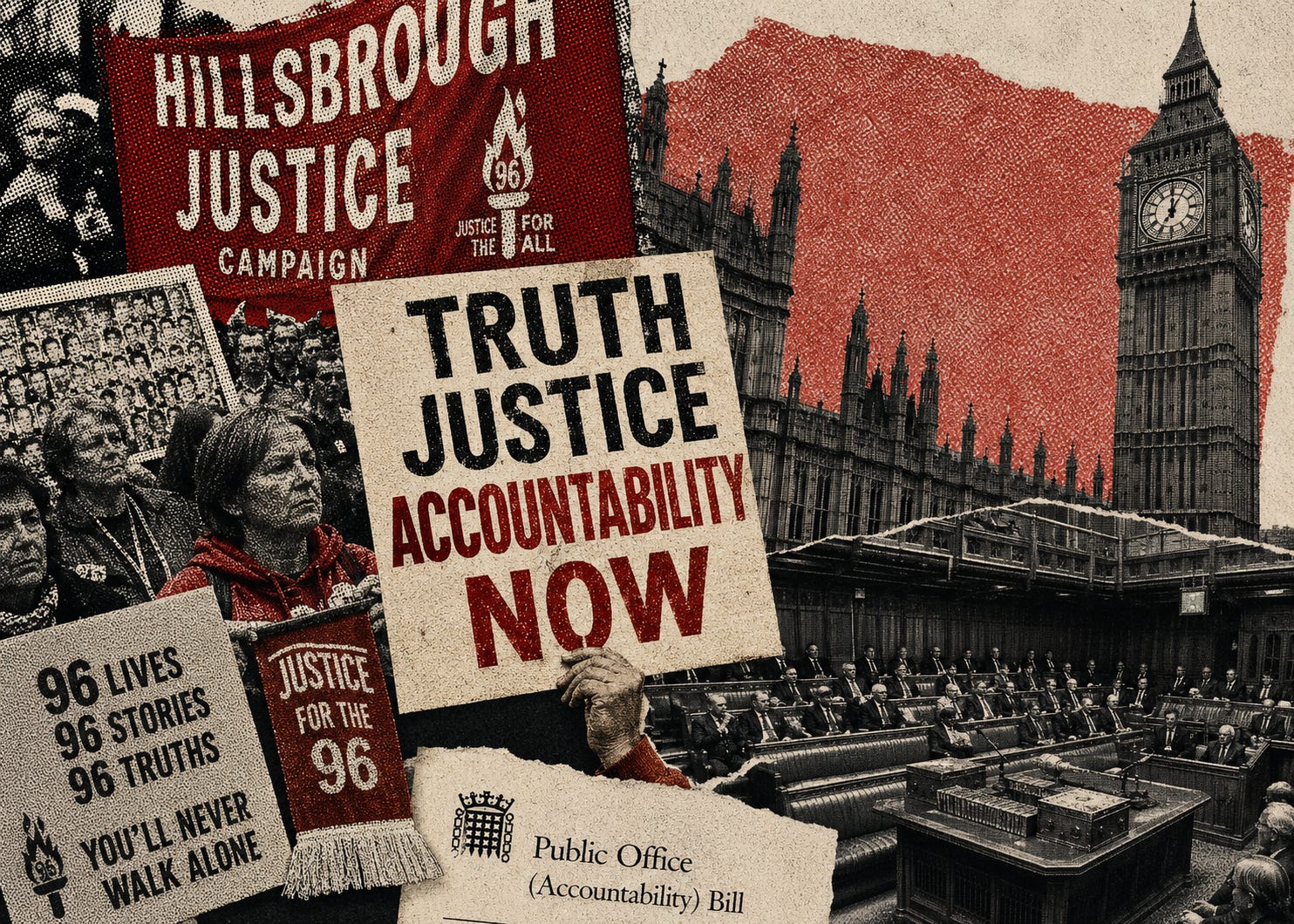
Into this profound crisis of confidence comes the Hillsborough Law, officially the Public Office (Accountability) Bill. Promised in Labour’s 2024 manifesto, it faced repeated delays and the Government sought to add carve-outs for intelligence services, prompting a massive backlash from campaigners. Just before Andy Burnham – a long-time proponent of the Law – took the helm of the nation, it passed the Commons intact and sans carve-outs.
So what is it? The law is first and foremost a response to one of Britain’s greatest injustices: the decades-long struggle by the families of the 97 Liverpool supporters who died at Hillsborough to uncover the truth about an egregious crowd control failure and the subsequent official cover-up. But its legacy may reach far beyond Hillsborough itself.
The Law as passed establishes a new expectation that those who exercise public power – from ministers and MPs to civil servants, police officers and public authorities – owe the public a duty of honesty and candour. Rather than entrusting ethical governance to “good chaps,” it creates a legal obligation in defined contexts, with new offences for seriously misleading the public.
So this legislation is designed with the full apparatus of the state in mind. Notably, after much back-and-forth, that now includes Britain’s intelligence services as well. Campaigners warned that blanket national security carve-outs – that time-tested "trust us, it’s classified” excuse – serve as a convenient shield to deny accountability. They won that fight in the Commons.
Coming down the pipeline is a historic constitutional shift. An implicit recognition that we can’t simply rely on our leaders to behave ethically, that there are systemic incentives towards manipulation and deception, and that we need binding rules to ensure we’ve got a fair political playing field.
I see it almost as a legislative bridge across that integrity gap, a way to pull our politicians and public officials back towards reality. An acknowledgement that citizens must matter in a real democracy, that their right to the truth now outweighs any official instincts for self-preservation.
So yes, this will change the default setting of British public life. It will shift the balance of power back towards citizens in a significant victory for democratic accountability and fairness. Well done to all who campaigned for it.
But there’s never just one silver bullet, is there? Our democratic crisis is so deeply embedded, our loss of trust so profound, that no singular piece of legislation is going to wash it all away.
The Hillsborough Law is a landmark reform, but it cannot be the end of Britain’s democratic renewal. If we’re to chart a better course forward, this should mark the beginning of a different philosophy of government: one that accepts integrity cannot be left to convention or the goodwill of those in power. It has to be built into the rules themselves.
The same principle should now be applied elsewhere. People will struggle to believe politics serves them while political finance remains opaque, corporate lobbying continues to operate in the shadows, and our voting system leaves millions feeling their voice carries less weight than others. These are all different manifestations of the same integrity gap.
If Andy Burnham truly wants to rebuild trust in our democracy, the Hillsborough Law should become the first chapter in a much broader programme of constitutional reform. One that shines more light on money and influence in politics, strengthens democratic accountability, and ensures every citizen has an equal voice in shaping the country’s future.
The reality is that the public’s loss of trust was always justified. They lost faith in a system that failed them. The only way to restore it is to build institutions that consistently behave in ways that earn it.

A very recent report by the UCL Constitution Unit shows that the United Kingdom’s uncodified constitution must be safeguarded if it is to protect the integrity of our democracy and produced 28 recommendations dealing with loopholes that could be exploited by unscrupulous governments as well as raising wider concerns. Then the House of Lords Constitution Committee announced yesterday that it would be holding an inquiry along the same lines. Hopeful? This shows that at least these issues are coming into public awareness.
So far so good, but a long way to go.