

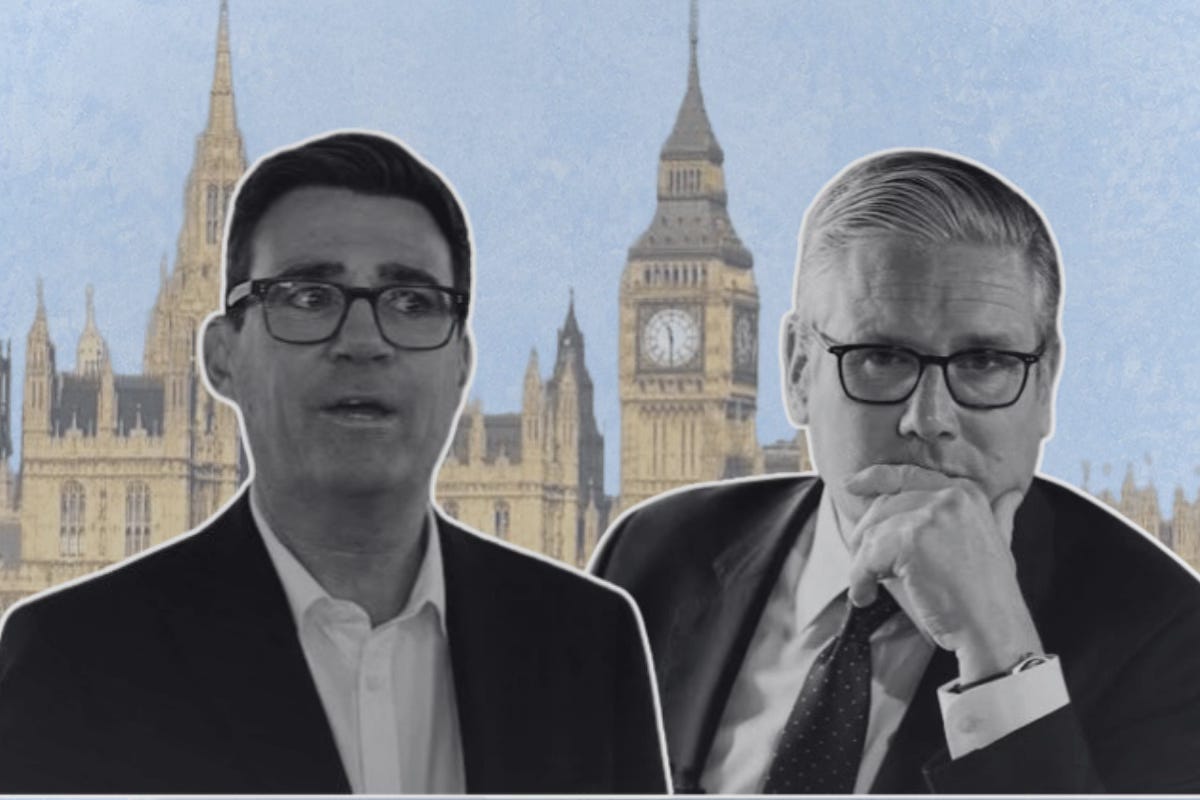
Today, Andy Burnham stepped up to the despatch box for the first time as Prime Minister, promising a different way of doing politics.
This week brings one of the first opportunities to show how different it will be.
The Representation of the People Bill returns to Parliament carrying some worthwhile reforms - and all the caution of the government that wrote it. It will lower the voting age to 16 and strengthen protections against foreign money entering British politics. Both deserve support.
The problem is how much the Bill leaves untouched.
Rushanara Ali, one of the ministers who helped write it, has described the Bill as too “timid” and “incremental”.
She is right.
The Bill extends the franchise without confronting what happens to people’s votes. It tightens some rules around foreign money while leaving British millionaires and billionaires free to donate almost any amount. It changes parts of our democracy while avoiding the deeper question of whether the system itself is working fairly.
Andy Burnham did not write this timid Bill. His choice is whether to accept it as a finished package.
The Bill was conceived under Keir Starmer and carries the limits his government chose for it. Those were political choices, not permanent boundaries. The previous government left some of the biggest questions facing British democracy for another day. Burnham does not have to inherit its caution along with the Bill.
That is what a change of Prime Minister can mean: not rejecting everything that came before, but reopening choices that were treated as closed.
Burnham did not become Prime Minister because the country wanted a more personable administrator of decisions made by Keir Starmer. His premiership carries an expectation of political departure. The revealing moments will come when he must decide whether the old limits still apply.
This is one of those moments.
Two of the biggest issues the Bill leaves open - money in politics and our voting system - offer Burnham the chance to set a more ambitious direction. On both, his own backbenchers are already creating the momentum for him to go further.
Britain still puts no universal limit on how much one person can give a political party.
Recent months have shown us where that leads. Reform UK has been engulfed by questions about Nigel Farage’s relationship with George Cottrell, the wealthy donor and convicted fraudster who helped bankroll the party.
Then there’s the revelation that Christopher Harborne gave Farage £5 million personally, just weeks before he decided to stand in the 2024 general election. Its size, timing and secrecy have raised questions that no healthy democracy should be comfortable leaving unanswered.
This is the bargain behind unlimited donations: wealthy people get extraordinary access and potential influence, political leaders get the money they need, and the rest of us are expected to trust that nothing passes between them.
Backbench MPs have tabled amendments to introduce a cap through the Bill.
Burnham knows the problem. Before becoming Prime Minister, he backed a cap of around £500,000. His Government has not backed those amendments, but says it has not ruled out returning to the issue later.
The choice is not between accepting these amendments exactly as written and doing nothing. If they are not right, the Government can improve them. The problem is clear and the opportunity to act is already here.
Later should not be the answer.
Electoral reform offers Burnham another opportunity to go beyond the package he inherited.
The 2024 election produced the most disproportionate result in modern British history. Tactical voting has become routine and millions of votes make no difference to the outcome.
Almost 100 Labour MPs are among 185 parliamentarians calling for a National Commission, with an amendment now before Parliament.
The Government has so far focused on whether changing the voting system would require a manifesto mandate.
That gets ahead of the decision actually facing Burnham.
A National Commission would not impose a new voting system. It would create an independent, evidence-led process, involve the public and allow the country to decide what should come next.
The immediate choice is not which voting system Britain should adopt. It is whether that process should begin.
The opportunity is also bigger than the amendment. Burnham can establish a National Commission with or without the Bill. He does not have to choose a new voting system this week. He can choose to start the process.
There is a danger that the Representation of the People Bill will be treated as a parcel that has already been sealed: worthwhile measures inside, difficult questions left out and too late now to change the contents.
It has arrived, however, at a more ambitious political moment than the one in which it was written. Its original limits do not have to determine what happens next.
Burnham does not need to accept every amendment or settle every detail immediately. He can commit to the principle of a donations cap and ask his Government to design one that works. He can launch a National Commission without waiting for another Bill or another election.
This is not an invitation to discard the Bill he inherited. It is an opportunity to give it the ambition its original authors withheld.
Today, Burnham promised a different way of doing politics. This Bill gives him one of his first chances to show us what that means.
He has inherited a timid Bill. He also has the opportunity to make it braver.

Mark: Please can you block "Roy Jenkins"? His posts are all ranting spam, clearly designed to undermine Ugly Politix. I'm all for freedom of expression, but it comes with responsibility.
It's a chance for Andy to live up to his name - Burn -em