

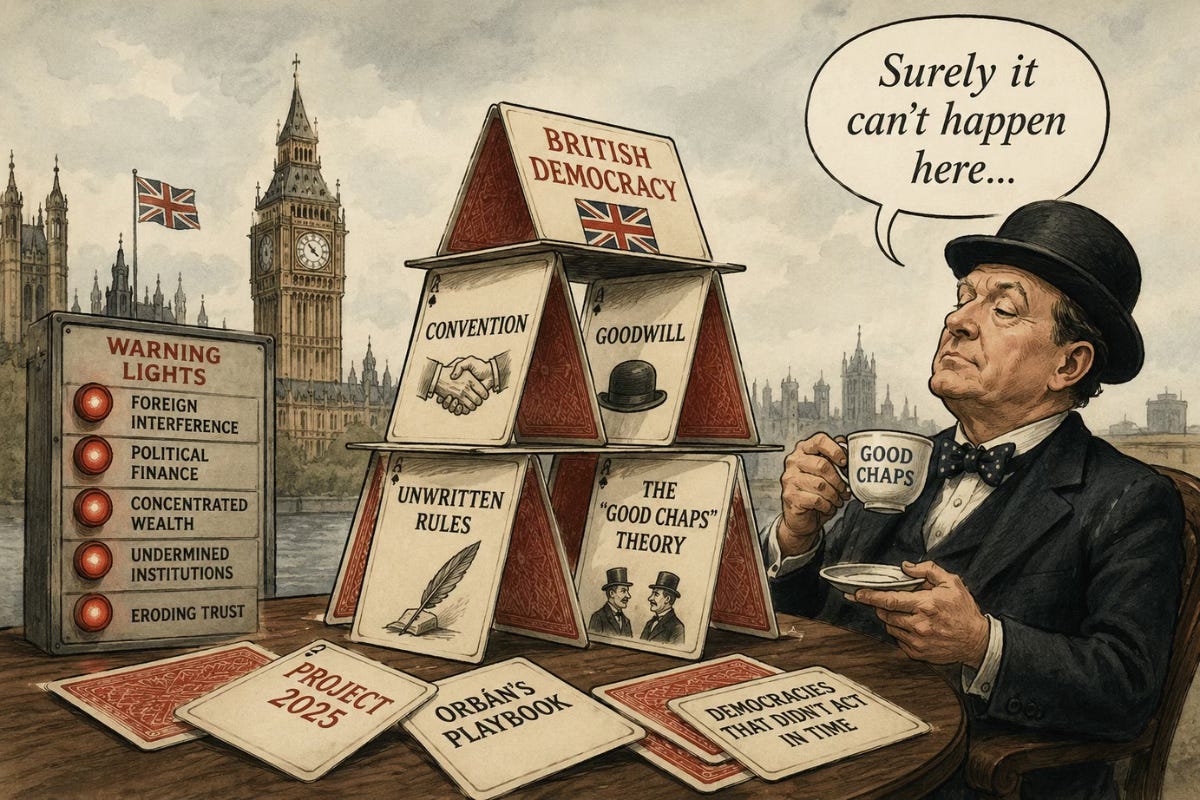
When Andy Burnham suggested this week that Britain may eventually need a written constitution, he opened the door to one of the biggest constitutional conversations this country has had in generations.
His immediate focus was devolution. As power moves out of Whitehall and into towns, cities and regions, Burnham argues the UK will eventually need a clearer constitutional settlement built around shared principles.
He’s probably right.
The danger is that we immediately start arguing about where the furniture goes instead of whether the house is fireproof.
Most debates about a written constitution quickly descend into questions of structure. Which powers should remain in Westminster? Which should sit with mayors, councils and devolved governments? How should the constitutional map be redrawn?
Those are important questions. They’re just not the first ones.
A written constitution shouldn’t be a photocopy of the system we’ve inherited. The more important task is deciding what a modern constitution should actually protect us from.
The world has changed dramatically over the past decade. Democracies have been tested in ways that once seemed unimaginable. Foreign interference has become a national security concern. Political finance has become more opaque. Public trust has continued to drain away. The comforting assumption that democracy will somehow look after itself feels far less convincing than it once did.
We don't have to imagine what happens when democratic safeguards fail. We only have to look around.
Hungary should be compulsory reading.
Viktor Orbán didn’t abolish democracy overnight. He won elections. Then, over the course of years, he systematically dismantled many of the institutions designed to limit executive power. Independent media was gradually brought under the influence of government allies. The Constitutional Court was weakened through changes to appointments and jurisdiction. Electoral laws were rewritten to favour the governing party.
None of those decisions, taken in isolation, looked like the end of democracy. Taken together they transformed Hungary into what Orbán himself described as an “illiberal state”.
The United States offers a different warning.
Project 2025 was an instruction manual for governing without the old constraints. Across almost 900 pages it mapped out how the Trump administration could remove senior civil servants, expand presidential control over supposedly independent agencies, weaken regulatory bodies, reshape the Department of Justice, concentrate executive authority and replace experienced officials with partisans.
It was a disturbing mix of ambition and strategy which treated democracy as a system to be reverse engineered.
America had plenty of warnings. They were all dismissed as alarmist. Until they weren’t.
One of the biggest mistakes democracies make is assuming they are somehow exceptional. Americans believed their Constitution would hold. Hungarians believed their democratic institutions would protect them. Somehow, Britain still clings to the belief that constitutional safeguards are something other countries need.
We prefer the “good chaps” theory of government: the idea that those in power will voluntarily play by the rules, respect unwritten conventions and politely refrain from exploiting every loophole available to them.
That’s less a constitutional safeguard than a fingers-crossed strategy.
If all of this still feels like someone else’s problem, Britain’s recent politics should make you think again.
Here’s the thing. The modern populist right does homework. It watches, borrows, shares tactics and learns. Nigel Farage didn’t stumble into Donald Trump’s orbit by accident. Political movements learn from one another. They study what works. Perhaps it’s time defenders of democracy started doing the same.
Britain already has enough warning lights flashing on the dashboard. Foreign interference is no longer a conspiracy theory but an established security concern. Political funding is increasingly concentrated in the hands of a tiny number of ultra-wealthy donors. Reform UK has attracted astonishing sums of money for a party barely out of infancy, while questions around transparency, financial influence and the conduct of senior figures have become regular fixtures of the news cycle.
None of these developments, taken individually, means Britain is destined to follow the path of Hungary or the United States. What they do tell us is that these aren’t hypothetical problems anymore. They’re already part of British politics.
Good constitutional design has never been about today’s government. It’s about tomorrow’s, and the one after that. Constitutions aren’t written because we trust politicians. They’re written because democracy shouldn’t depend on trusting them.
That shifts the debate away from constitutional plumbing and towards the questions that actually matter. How do we stop vast wealth buying disproportionate influence, defend elections from foreign interference and make sure new technologies don’t undermine democracy? Above all, how do we ensure that the rules of our democracy aren’t simply rewritten by whichever party happens to win the next election?
Andy Burnham is right that Britain may need a new constitutional settlement. But the real opportunity isn’t to write down the rules we’ve inherited. It’s to write the rules we’ve learned we need.
Hungary showed us how democracies can be hollowed out. Project 2025 showed us that someone is already writing the playbook. Britain still has limited time to strengthen the guardrails around our democracy, something both Hungary and the US once believed they had in abundance.
Constitutions are usually written after democracies learn painful lessons. The real test is whether Britain can learn them first.

Firstly, what a fine (but uncredited) illustration heads the article.
Secondly, you've made some important historic points, Cathy, I just hope that the detestable Trump's influence does not become even more pervasive and so extinguish the Burnham glimmer that we are currently experiencing.
I have long felt that the U.K. is a truly broken country where all the energy of successive governments is spent or misspent in fire-fighting the fallout from its many failing public services or resolving the endless scandals around internal party politics. The sheer lunacy of UK’s decision to withdraw its membership of the EU is now all too plain to see as the country struggles to give impetus to its economy and unemployment starts to rise. Where are the individuals in politics who not only have a long term vision for the country but also have the ability to articulate said vision to a public that desperately needs at least some level of certainty for the country’s long term future?! Its real problems however are not just confined to the discussion on the calibre of the politicians but in my view are to be found in the very fabric of its shaky democracy.
A rigged electoral system, vainglorious parliamentary practices and procedures, a second house that progressively loses relevance as it fills up with political appointees of dubious repute, a convoluted constitution muddied in the mists of centuries past and a head of state who leads a family mired in scandal most of whom continue to exist in a bubble of obscene wealth and privilege - all mean that the U.K. is a democracy in name only.
I actively support the growing cross-party lobby in parliament that is pushing currently for electoral reform as I truly believe that this is where a much needed radical shift in British politics and overall governance begins. Coalition government is not a magic bullet to heal a deeply wounded society but at the very least it is intrinsically more democratic than the farcical two party model the country operates today. I would like to see a future government extend the reform to embrace the idea of a written constitution which the man in the street can understand and perhaps even swear allegiance to, an abolition of the monarchy in favour of an elected head of state and an elected second house. My wish list for the country would also include an examination of parliamentary practice and infrastructure with a view to mothballing the Houses of Parliament and replacing it (using the 60 billion quoted for reparations to said relic) with the construction of debating chambers fit for the 21st century - not necessarily based in London!