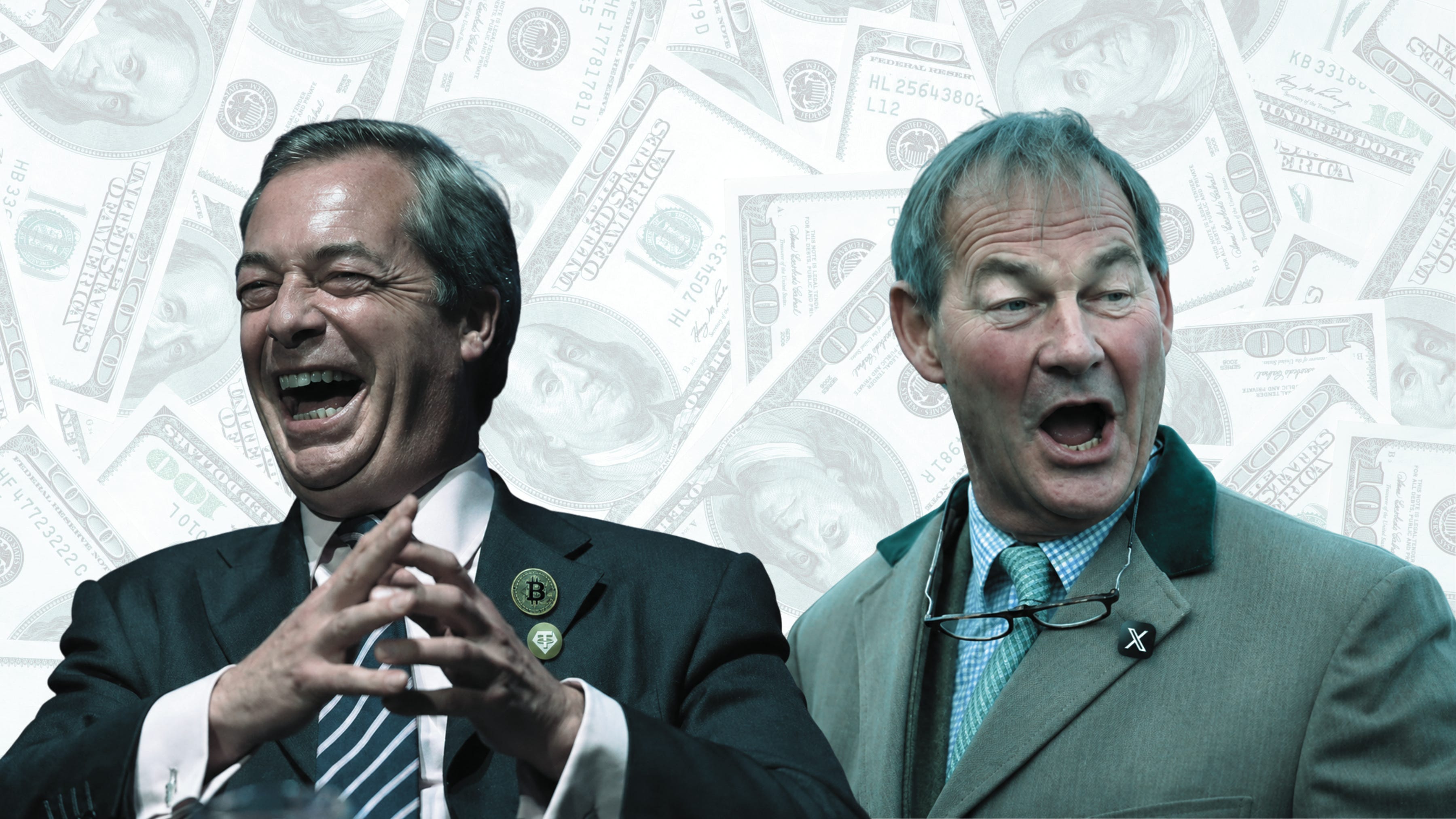
Having lived in the States and written about American politics for years, the amount of money involved in British donation scandals can sometimes feel surprisingly small. The hard reality for us at the moment is that the bankrollers of US politics are breathtakingly well-resourced. They view Britain’s politicians as an absolute bargain. And they’re looking for a new venture.
Sixteen years ago, a key US Supreme Court decision (Citizens United) solidified the idea that money was a form of political speech. Those who said it at the time were largely ignored, but it truly set the stage for a Presidency like Donald Trump’s.
Fast forward fourteen years, and the total election expenditure during the US’ 2024 cycle was a whopping $14.8 billion (roughly £11 billion). It’s the second highest of all time, beaten only by an inflation-adjusted $18.3 billion (£14.6 billion) spent in 2020. These are astronomical sums of money for political campaigns – more than any other country on Earth.
The United States is about seven times richer than the UK by GDP and about five times larger by population. But its federal elections in 2024 consumed more than 115 times as much money as Britain's 2024 general election campaign (£94.5 million).
At first glance, that disparity might sound reassuring. You might say that Britain has seemingly avoided the runaway arms race of American campaign finance so far. But our figures are increasing with each election at pace. The opposite conclusion may ultimately be closer to the truth.
Because British politics is so much cheaper, it is also far easier to influence. Indeed, many of Britain’s most potent donation scandals would barely register in American politics.
Reform’s former Welsh leader Nathan Gill was bribed by pro-Kremlin interests for a paltry £40,000. Going further back, Neil Hamilton's career was effectively destroyed over allegations involving payments of roughly £2,000 per parliamentary question.
Even Christopher Harborne’s £5 million gift to Farage – unprecedented and absolutely staggering in British politics – pales in comparison to the $277 million Trump received from Elon Musk or the $100 million he received from Israeli billionaire Miriam Adelson.
Britain offers a better return on investment.
As Oliver Bullough, author of the very good book Butler to the World puts it: US billionaires could buy Britain for the cost of a single senate seat in Texas. “And, let’s face it, that money wouldn’t be going to the Greens, to Labour, or even to the Lib Dems.”
If Farage (or Rupert Lowe) are as good an investment as Trump, they could open new, unregulated markets for fraud-laden cryptocurrencies. They could slash regulations, dismantle public assets, weaken labour protections, and appoint sympathetic figures to key regulatory bodies. And best of all, they can be bought on the cheap.
The great danger is that our political system is utterly ill-equipped to stop any of this from happening. We’re barrelling towards outright oligarchy, and that risk is no longer abstract. You can look at Trump’s America and see it clearly. Once an oligarch class becomes entrenched, they have a tendency to disassemble democratic safeguards and accountability mechanisms. They can be nigh on impossible to dislodge.
So we’re sat here at this critical juncture, our governing party squabbling within its ranks, utterly distracted from the impending tidal wave poised to hit our shores.
How do we stem the tide?
MPs are working to strengthen the tepid campaign finance reforms in the Government’s Representation of the People Bill (RPB). The measures currently proposed, including a £100,000 donation cap for Brits living abroad and a moratorium on cryptocurrency donations, are certainly welcome. But they’re just not going to be enough.
MPs are putting forward a range of amendments, most notably a proposal to limit annual donations to £1 million a year for all British donors. Others argue for restrictions on cash donations from specific types of donor – fossil fuel companies, property developers, cryptocurrency companies, and companies attached to public contracts. All of these are welcome in my view.
And we’ve long argued that a stronger Electoral Commission – which never really recovered after Boris Johnson stripped its powers in 2022 – is a necessity. What good are campaign finance laws if they’re not being comprehensively enforced and not properly deterring bad actors?
Bullough, who knows a thing or two about how dark money works in Britain, argues we should go even further. Only people on the electoral register can vote, he writes, so they should be the only ones eligible to donate. No more shell companies, no more unincorporated associations. He suggests donations be made in sterling with proper background checks (to prevent ineligible individuals donating by proxy), capped at £100,000 per elector.
He also points to a key avenue of influence-buying that is seldom discussed in these debates: the media contract. GB News and Elon Musk’s X are bankrolling politicians on the far-right. They’re another channel through which billionaire cash can enter our political system.
In essence, we need a system so simple, so air-tight, that it can stand guard against a class of people who seek to own the world. Our outdated 1990s-style system of regulation isn’t going to last long in the new digital dark money frontier we find ourselves in. It’s time for a comprehensive update. Starting with this RPB. And not stopping after that.