

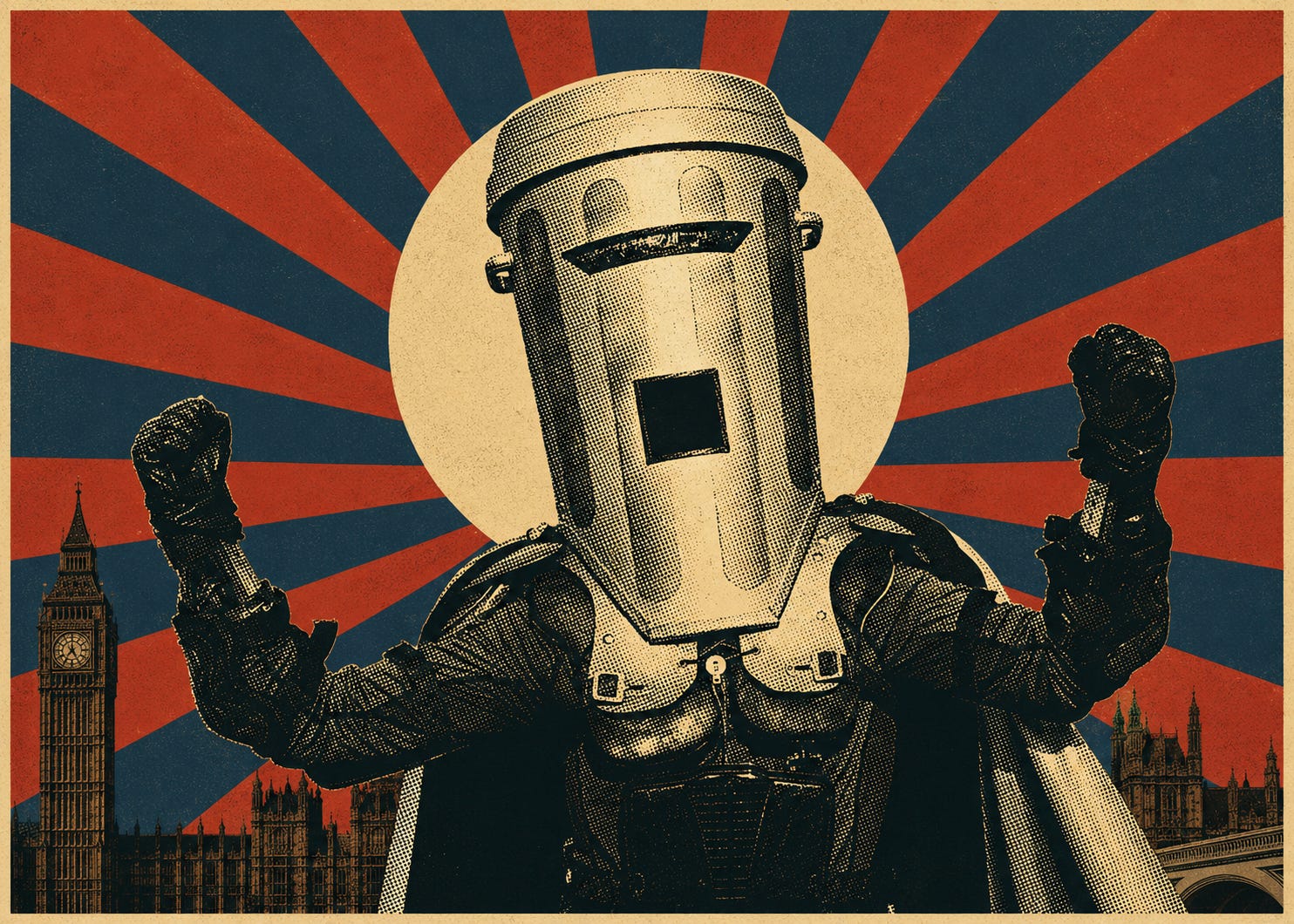
Count Binface, Nigel Farage’s opponent in his shambolic Clacton by-election, belongs to a rich British tradition of mercilessly lampooning politics. But is there any deeper point to these ‘intergalactic space warrior’ shenanigans?
The Reform UK team and their media pals are keen to tell us about the man under the lid. Jonathan Harvey, the comedian behind Count Binface, is an anti-Brexit Oxford graduate who has written for The Thick of It and the BBC’s Have I Got News For You. In Reform’s mirror universe, this apparently makes him a card-carrying member of Britain’s left-wing cultural elite. As Simon Evans argued recently in Spiked, Binface is somehow “the establishment candidate”.
It all comes across as rather desperate. Nigel Farage has spent decades casting himself as the anti-establishment outsider. Yet in calling a by-election to escape a mounting sleaze scandal, only to find himself squaring up to a man in a silver dustbin, he has thoroughly hoisted himself on his own petard. This whole election is a joke. Increasingly, thanks to Count Binface, Nigel Farage himself seems to be the punchline.
Still, it’s fair enough to ask what the Bin is seeking to gain from all of this.
It certainly isn’t about the money. Since first appearing against Theresa May as Lord Buckethead in 2017 (before a copyright dispute forced the move to Count Binface), Harvey has routinely forfeited his £500 candidate deposit, donating surplus crowdfunded donations to charities such as Shelter.
Nor is he pursuing some narrow partisan cause. He stood against Andy Burnham in Makerfield. He promises to fill potholes in Clacton with surplus copies of Labour’s 2024 manifesto. Watch his Oxford Union speech from a few years back and you’ll find him mocking virtually every party in Westminster, arguing that “fakery” has come to define British politics.
And it’s not exclusively about attracting attention, though Nigel Farage has given him an unprecedented national spotlight. The Count has already had his fair share of photos on stage with various Prime Ministers, and he’s already the subject of media spectacle and countless internet memes.
The project, in fact, seems to be somewhat personal. Writing under his own name, Harvey has described losing his brother Dan, with whom he shared a love of politics, football and comedies like Blackadder. Count Binface, he says, is in part a tribute to his brother – a way to “help his joy continue to radiate.”
But grief, in Harvey's hands, doesn't curdle into bitterness; instead, it channels into something more useful: a refusal to take seriously a political class that has long stopped deserving seriousness.
What if beneath this metallic cylinder there is someone genuinely frustrated by what our politics has become, who is using their comedic stylings as a clarion call for people to wake up and realise how ridiculously broken this system has become?
There is a great deal of precedent there. Even before Britain developed its longstanding penchant for ridiculous novelty candidates, medieval court jesters had a special license for brutal honesty, often the only people permitted to mock monarchs to their faces. The king claimed to speak for his people, but the jester could truly voice the raw, crude feelings that others tiptoe around.
That explains why Binface has become such an unexpectedly effective foil for Nigel Farage.
Farage’s politics have always depended on the carefully cultivated persona of the renegade outsider. He’s even used a certain type of comedy (often petty personal insults) to signal his status as an insurgent against the Westminster system.
But now he’s running an indignant, defensive, and cynical campaign, with expensive ads and fiery rhetoric, against a refuse-themed science fiction character. He increasingly looks like the establishment insider by comparison to the Count. And Binface is very happy to keep ribbing him for being a quintessential Westminster politician, complete with billionaire donors, a permanent spot on Question Time, and more time spent in Washington than in Clacton.
Kemi Badenoch put it best: “If it’s the people versus the establishment, I think Nigel Farage might be looking like the establishment, and Count Binface may be the people.”
In an age when politicians are endlessly media-trained, focus-grouped and coached to death to appear authentic (often flopping horribly) Count Binface is the only candidate who is open about the theatrics he’s putting on. Standing in a silver dustbin, he exposes the fact that everyone else is acting too.
The bookies say he has a genuine, if slim, chance of winning Clacton. And that says as much about our politics as it does about him.
In a system drowning in pandering and performance, it’s no surprise that someone willing to point out the props has found an audience.
Binface is clearly intelligent and principled. Were he to win, he might turn out to be a good MP and likely a big improvement on the recent incumbent (OK, not a high bar!) After all, ex-entertainer Zelenskyy seems to have done a pretty good job in Ukraine.
Binface winning would be the best thing to happen this decade. And the last one too